In This Guide
- What Exactly Is a Sarcastic Fringehead?
- Where Do You Find This Grumpy Fish?
- A Day in the Life of the Angriest Fish in the Sea
- Can You Keep a Sarcastic Fringehead as a Pet?
- Sarcastic Fringehead vs. The World: How It Stacks Up
- Your Sarcastic Fringehead Questions, Answered
- Final Thoughts: Appreciate the Spectacle, Respect the Animal
Let's be honest, you probably clicked on this because of the name. "Sarcastic fringehead." It sounds like a witty insult from a Victorian novel, not a fish. But trust me, the reality is even stranger than the name. Picture this: a small, eel-like creature, mostly brown and mottled, looking fairly unassuming. Then it opens its mouth.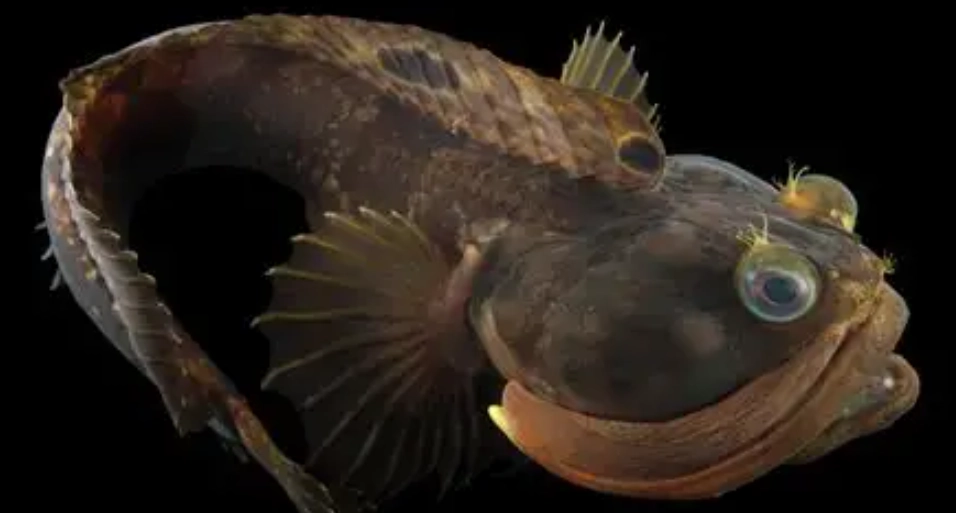
And I mean really opens its mouth. Its head seems to split in half, unfolding a massive, fluorescent-lined gape that looks like a psychedelic nightmare. This isn't for eating you (it's only about 6-10 inches long, after all). It's for one thing: pure, unadulterated intimidation. I've spent a lot of time reading about weird marine life, and the sarcastic fringehead fish consistently tops my personal list of "animals with attitude problems." It's not just aggressive; it's performatively, hilariously aggressive. This guide is my deep dive into everything about this pugnacious little fish. We'll strip away the internet memes and look at what it really is, why it acts that way, and whether you'd ever, in a million years, want to keep one.
Key Takeaway Right Up Front: The sarcastic fringehead (Neoclinus blanchardi) is a small, territorial fish found off the Pacific coast of North America. Its claim to fame is its enormous mouth, used in spectacular "gaping" displays to scare off rivals and predators. It's a fascinating example of evolutionary adaptation, but a terrible candidate for a home aquarium. Its attitude is worse than its bite.
What Exactly Is a Sarcastic Fringehead?
First, the boring science stuff (it's important, I promise). The sarcastic fringehead is a species of blenny. Blennies are a huge family of mostly small, bottom-dwelling fish. But while some blennies are cute and perch on corals, the fringehead took a different evolutionary path. It belongs to the "tube blenny" or "chaenopsid" family, fish known for being... well, feisty and for living in protective tubes or burrows.
The name "sarcastic" is thought to come from its sardonic, grimacing appearance when its mouth is closed. "Fringehead" refers to the floppy, frilly appendages (cirri) above its eyes. Honestly, the "sarcastic" part fits perfectly once you see its behavior. It has the demeanor of a grumpy old man defending his favorite park bench.
Physically, it's built for a life of lurking and lunging. It has a long, scaleless body, perfect for wriggling into tight spaces. Its eyes are perched high on its head, so it can peek out of its home without exposing much of its body. Its pectoral fins are large and help it brace inside its lair. But the pièce de résistance is the jaw mechanism.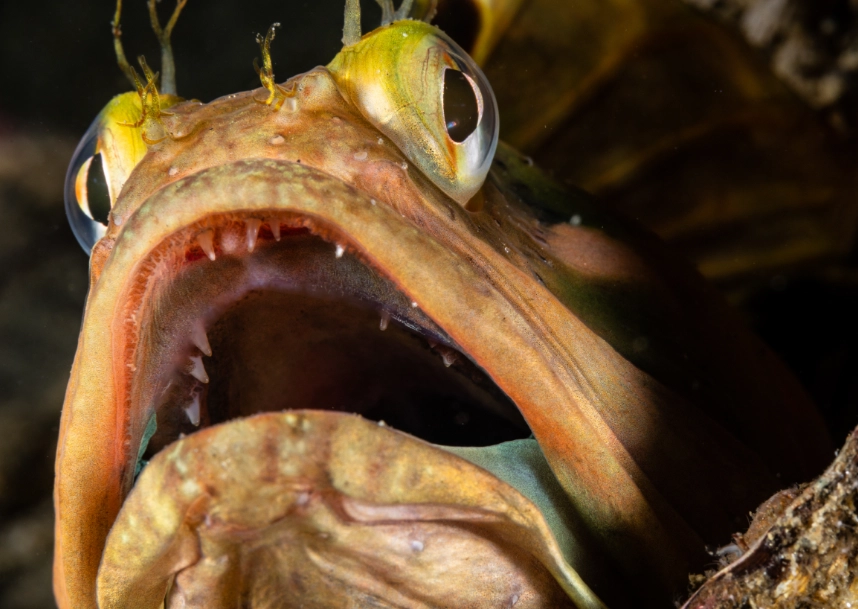
The Anatomy of an Epic Temper Tantrum
Let's talk about that mouth. The upper jaw (premaxilla) is loosely attached. When the fish opens wide, this jaw swings forward and downward like a drawbridge, increasing the gape exponentially. The inside of this oral cavity is often bright white, yellow, or even electric blue, creating a shocking visual contrast. Researchers at the California Academy of Sciences have studied these displays extensively. It's not just a party trick; it's a highly evolved form of communication and combat.
Why go to all this trouble? In the dark, murky world of the seafloor, visual signals are key. A bigger, brighter display means a bigger, badder opponent. It's a way to settle disputes without getting hurt—a classic case of "talk big, avoid the fight." Most encounters between two sarcastic fringehead fish end with the smaller one backing down after a mouth-off. Literally.
Fun (and Slightly Unsettling) Fact: During these mouth-wrestling contests, the two fish will press their wide-open mouths together, almost like a kiss of death. They're not biting; they're comparing size. The one with the smaller mouth loses. It's the underwater equivalent of two people arguing about who has a bigger... well, you get the idea.
Where Do You Find This Grumpy Fish?
If you're diving off the coast of California and want to spot one, you need to know where to look. The fringehead fish has a specific taste in real estate.
- Geographic Range: From San Francisco, California, all the way down to central Baja California in Mexico. They're a Pacific coast specialty.
- Depth: They're not deep-sea monsters. You'll typically find them between 10 and 250 feet deep. Recreational divers can sometimes spot them.
- The Habitat is Everything: This is the crucial part. Sarcastic fringeheads are homebodies. They are obligate dwellers of pre-existing holes, crevices, and burrows. What kind of holes? Anything they can fit their body into.
And here's where it gets interesting. Their favorite homes are often discarded human trash. I wish I was kidding.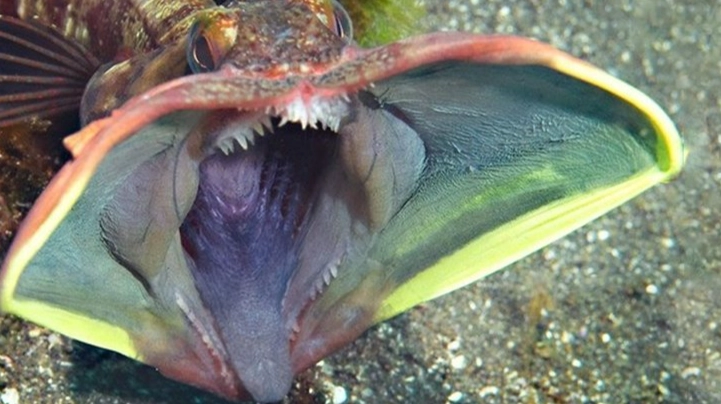
My Personal Pet Peeve (and an Ecological Point): You'll see countless videos online of fringeheads in glass bottles or cans. While it's a stark reminder of ocean pollution, it also shows their incredible adaptability. They don't care if it's a natural rock crevice or a Heineken bottle—if it's a hole, it's home. But it's a sad sight, really. It highlights how our waste directly becomes part of the marine ecosystem, for better or (mostly) worse.
They'll also use empty mollusk shells, abandoned worm tubes, or even burrows made by other animals. The key is that the entrance is just big enough for them to get in, but small enough to defend easily. They spend most of their lives with just their head poking out, watching the world go by with a perpetual scowl.
A Day in the Life of the Angriest Fish in the Sea
So what does a sarcastic fringehead actually do all day? It's not a thrilling schedule, to be honest.
- Wake up grumpy. (I'm assuming).
- Peek out of hole. Scan for food (small crustaceans, worms) and threats.
- Lunge at passing snack. With lightning speed, it darts out, grabs the food, and retreats back to safety. Its ambush predator game is strong.
- Defend hole at all costs. This is the main event. Another fish approaches? Mouth display. A crab gets too close? Mouth display. A curious diver's finger? You guessed it—maximum gape. Their territoriality is off the charts. The Monterey Bay Aquarium, which has occasionally displayed them, notes the immense challenge of housing them with anything else. They are the ultimate solo artists.
- Repeat until death. Their life span is about 6 years, which is 6 years of steadfast, unwavering commitment to being territorial.
It's a simple, focused life. Their entire existence revolves around that one perfect hole. Which leads us to the big question hobbyists always ask...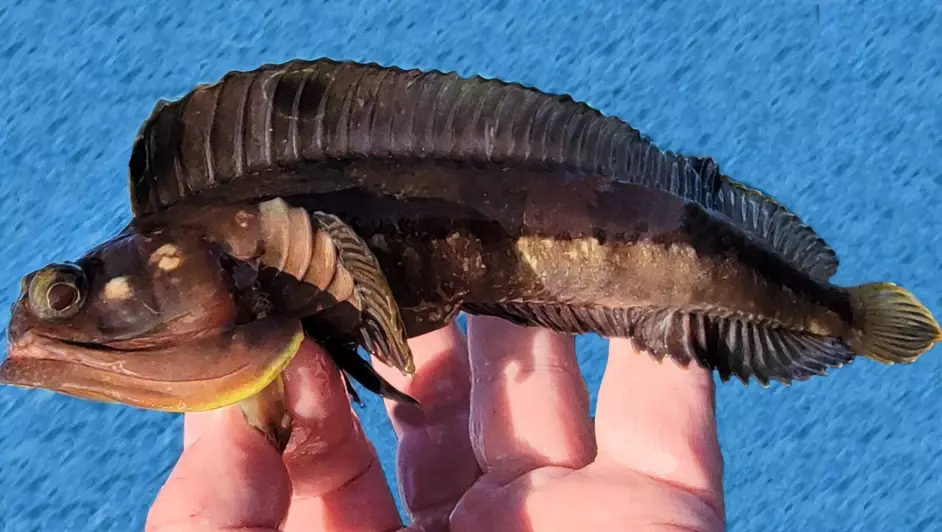
Can You Keep a Sarcastic Fringehead as a Pet?
I hear this all the time. "It's so cool! I want one in my tank!" Let me be the voice of reason. No. Just no. Or at least, not unless you are a highly experienced, specialized marine aquarist with a tank setup for a single, asocial predator. And even then, it's ethically questionable.
Here’s a brutally honest breakdown of why a sarcastic fringehead fish is a nightmare pet for 99.9% of people.
| The Dream (Why You Think You Want One) | The Harsh Reality (Why You Don't) |
|---|---|
| The Amazing Display: You want to see that giant mouth! | You'll only see it if it's stressed or feels threatened. A happy fringehead in its hole is a hidden fringehead. You're essentially paying for a pet you'll rarely see perform its one trick. |
| Unique Conversation Starter: "Check out my angry fish!" | It will attack and likely kill any other fish, shrimp, or crab you try to put with it. Your tank will be a one-fish show. Forever. |
| Cool, Easy Pet: It's small, right? | Specialized Diet: They often only accept live foods like brine shrimp, mysis shrimp, or small live ghost shrimp. Converting them to frozen food is very difficult. Expert-Only Water Params: They need pristine, cold saltwater (mid-60s °F), which requires a chiller—an expensive piece of equipment. |
| It'll be fine in my community tank. | This is the biggest mistake. They are NOT community fish. They are solitary, hyper-territorial assassins. Putting one in a community tank is a death sentence for your other livestock. It's cruel to all involved. |
I once talked to a seasoned aquarist who tried keeping one in a species-only tank with plenty of PVC pipe "holes." He said it was like watching paint dry, but paint that would occasionally try to murder its own reflection. He re-homed it to a public aquarium within six months.
If your heart is still set on a blenny with personality, look into the much more manageable (and visible) bicolor blenny or tailspot blenny. They have charm without the homicidal tendencies.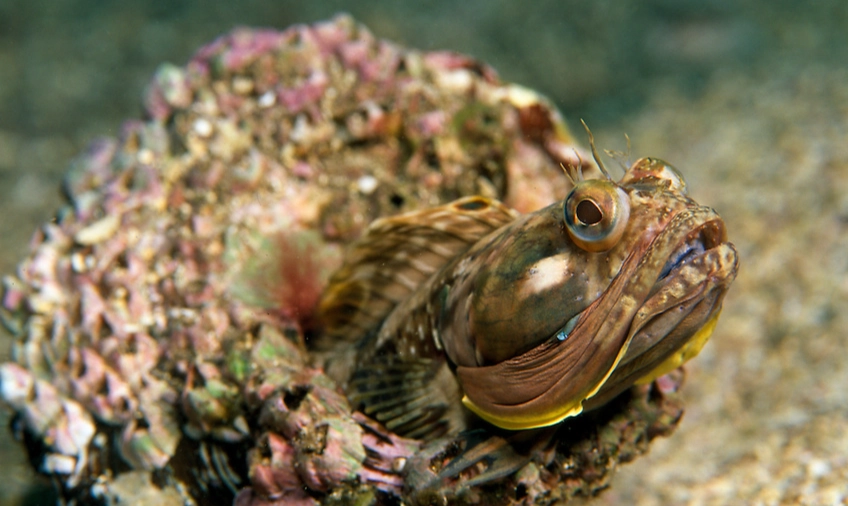
Sarcastic Fringehead vs. The World: How It Stacks Up
People love comparisons. Is the sarcastic fringehead the most aggressive fish? Let's put it in context with other famously feisty fish.
The Triggerfish: Bigger, stronger, can actually take a chunk out of a diver. But its aggression is more generalized. The fringehead's aggression is a focused, laser-guided defense of one square foot of real estate.
The Mantis Shrimp: A different phylum altogether, but often in the "cool aggressive animal" conversation. The mantis shrimp has the tools (smashing or spearing claws) to back up its attitude. The fringehead is all bluff. It's pure psychological warfare.
Other Blennies: Most are territorial, but the scale of the fringehead's display is unmatched. Its mouth-to-body-size ratio is one of the largest among all fish. That's its whole strategy.
So is it the "most" aggressive? Not in terms of physical damage it can inflict. But is it the most theatrically aggressive, the most committed to the bit of looking terrifying? I'd give it the gold medal for that.
In the end, its aggression is a brilliant survival strategy for a small, vulnerable animal. It's all about appearing larger than life.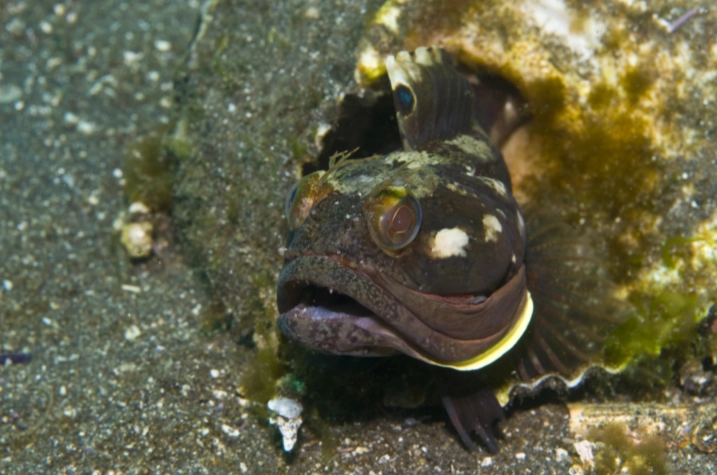
Your Sarcastic Fringehead Questions, Answered
I've scoured forums, read scientific papers, and watched a truly absurd number of YouTube videos. Here are the real questions people are asking about the sarcastic fringehead fish.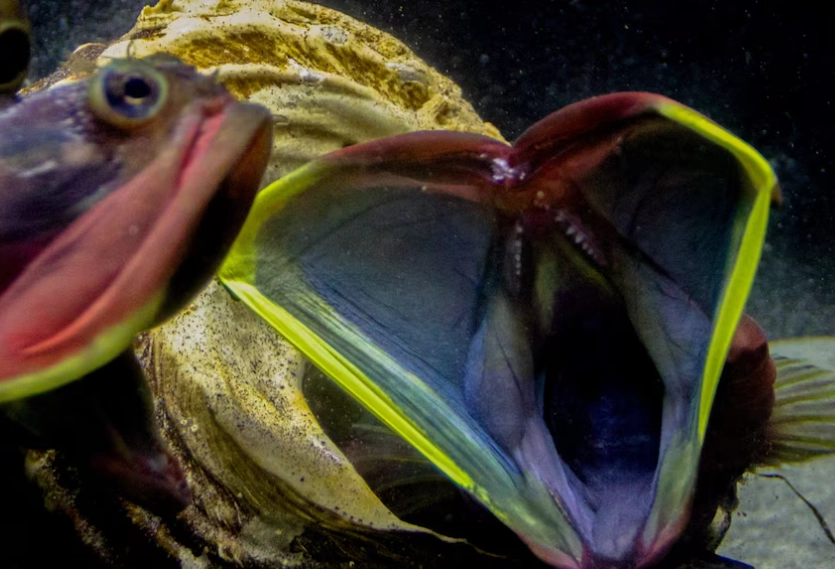
Final Thoughts: Appreciate the Spectacle, Respect the Animal
The sarcastic fringehead is a masterpiece of evolutionary niche-filling. It took the simple blenny blueprint and cranked the drama dial to eleven. It's a reminder that in nature, sometimes the best defense is a really, really good offense—even if it's just for show.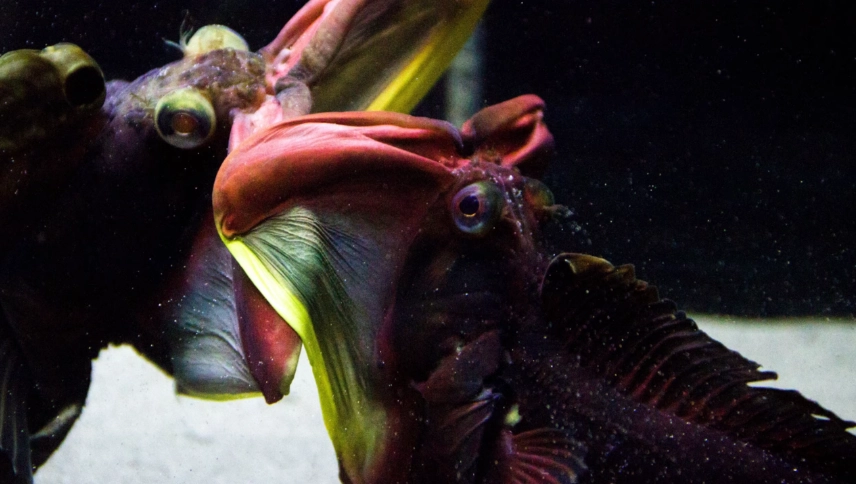
Its viral fame is a double-edged sword. It brings attention to a weird and wonderful corner of marine biology, but it also fuels an unhealthy desire to own one as a novelty. My hope is that after reading this, you appreciate it more as a wild animal, perfectly adapted to its specific, hole-dwelling life.
The next time you see that viral GIF of a fish sarcastic fringehead exploding out of a bottle, you'll see more than just a funny animal. You'll see a dedicated homeowner, a master of bluff, and a tiny testament to the sheer, bizarre creativity of life under the sea. Just maybe admire it from a distance—it prefers it that way anyway.




Comments
Leave a Comment