Sailor's Log: Quick Navigation
- What Exactly Is a By-the-Wind Sailor?
- The Sail: A Genetic Lottery with a Direction
- The Life Cycle: From Tiny Medusa to Blue Fleet
- By-the-Wind Sailor vs. The Portuguese Man O' War
- Why Do Millions Wash Ashore? The Science of Strandings
- Their Role in the Ocean (And On the Beach)
- What to Do If You Find One (A Practical Guide)
- The Big Picture: Drifters in a Changing Sea
Walking along the tide line, you've probably seen them. Little blue-purple ovals, maybe the size of a credit card, looking like discarded plastic or a weird piece of jelly. But pick one up (gently!) and you'll find it's firm, slightly crunchy, with a delicate, clear sail set diagonally across the top. You've just met Velella velella, better known as the by-the-wind sailor. It's one of the ocean's most common yet utterly bizarre passengers, and its life story is wilder than any fiction.
I remember the first time I saw a mass stranding. The beach near my old place in Oregon was carpeted in blue, millions of them, for what seemed like miles. It was surreal and beautiful, but also a little sad. I had no idea what they were. Jellyfish? Baby octopuses? Spoiler: they're neither. That confusion is super common, which is why I wanted to piece together everything we actually know about these creatures. The science is cool, but the reality of their life is even cooler.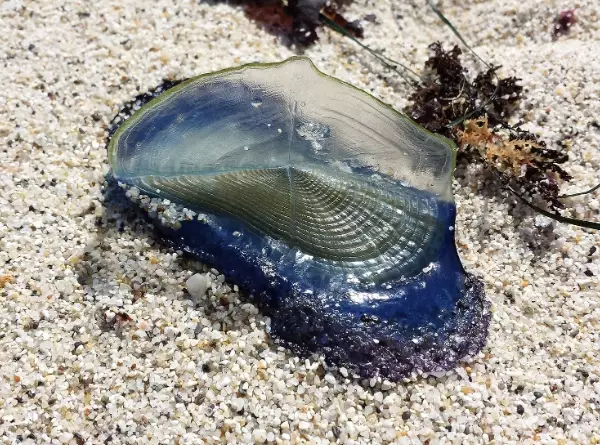
Here's the mind-bending part right off the bat: a single by-the-wind sailor isn't a single animal. It's a colony. A floating, cooperative city of thousands of tiny, genetically identical individuals called zooids, all working together to survive in the open ocean. Think of it as a living raft with a built-in sail. That sail isn't random decoration—it's the key to its entire existence and the reason for its name.
What Exactly Is a By-the-Wind Sailor?
Let's clear up the taxonomy, because it's a frequent source of mix-ups. The by-the-wind sailor belongs to the Phylum Cnidaria, which puts it in the same broad family tree as jellyfish, sea anemones, and corals. More specifically, it's a hydrozoan. But calling it a jellyfish is like calling a dolphin a fish—an understandable but incorrect shortcut.
The entire structure you see washed up is the float or pneumatophore. It's made of chitin (the same stuff as insect exoskeletons) and is gas-filled, keeping the colony at the surface. Below this float dangles a central "stem" from which all the specialized zooids hang.
The Crew on the Blue Raft
Every zooid in the colony has a job. It's a perfect, tiny division of labor.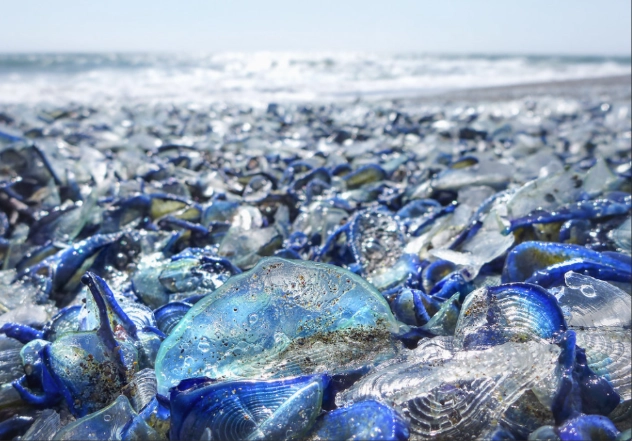
- Gastrozooids: These are the mouths. They hang down like little tentacles, armed with stinging cells (nematocysts) to capture plankton—their sole food source. They digest the food and share nutrients with the rest of the colony through a shared "stomach" network.
- Dactylozooids: The defenders. Longer and more tentacle-like, their primary role is protection, also packed with stinging cells to ward off potential predators.
- Gonozooids: The reproductive units. They look like small knobs or bunches and are responsible for producing the next generation.
So, the creature you hold is a superorganism. It eats, defends itself, and reproduces as one entity. I find that concept utterly fascinating. It challenges our basic idea of what an individual animal is.
The Sail: A Genetic Lottery with a Direction
This is the coolest bit, in my opinion. The stiff, triangular sail is set on a diagonal. In some populations, the sail runs from northwest to southeast (a "left-handed" orientation). In others, it runs northeast to southwest ("right-handed"). This isn't random. It's genetically determined.
Why does this matter? Prevailing winds in the Northern Hemisphere, like the westerlies and trade winds, tend to blow in consistent directions. A left-handed sail will catch the wind and push the animal to the right of the wind direction. A right-handed sail will push it to the left. This is a primitive but effective dispersal mechanism.
The theory is that this genetic variation prevents the entire global population from being blown onto the same shore. When winds shift seasonally, different variants get stranded, while others are blown back to safer open water. It's a survival strategy based on not putting all your eggs (or sails) in one basket. You can find a great, detailed breakdown of this hydrodynamic phenomenon in research archived by the National Oceanic and Atmospheric Administration (NOAA).
I've read some overly romantic descriptions claiming the by-the-wind sailor "chooses" its course. Let's be real—it doesn't. It's entirely passive. The sail just ensures it doesn't sit still. Its journey is a beautiful, poignant kind of helplessness. Its fate is literally written in the wind and its genes. There's something almost poetic about that, even if it's not conscious.
The Life Cycle: From Tiny Medusa to Blue Fleet
The reproduction of Velella velella is a complex, two-stage affair that explains how they can appear in such staggering numbers seemingly out of nowhere.
- The Colony Stage: This is the familiar blue float we see. The gonozooids on the colony release tiny, male or female medusae (think: miniature, pinhead-sized jellyfish).
- The Medusa Stage: These tiny, free-swimming medusae are the sexual phase. They release eggs and sperm into the water. After fertilization, the resulting larva develops into a new polyp.
- Back to the Colony: This polyp then undergoes a process of budding and growth, multiplying asexually to form all the different zooids that eventually become a new, recognizable by-the-wind sailor colony.
It's a classic alternation of generations, common in cnidarians, but seeing the result wash up in the millions really drives home how effective this strategy is for open-ocean drifters. The Monterey Bay Aquarium Research Institute (MBARI) has captured incredible footage of the delicate medusa stage in the deep sea, reminding us that most of this life cycle happens far from our view.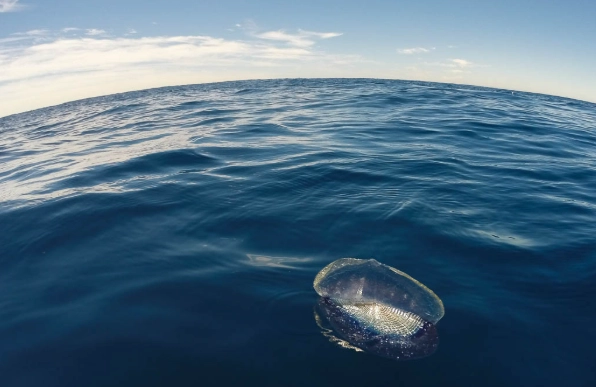
By-the-Wind Sailor vs. The Portuguese Man O' War: Don't Get Them Mixed Up!
This is the most important practical distinction for any beachgoer. They look vaguely similar—blue float, tentacles below—but the difference in risk is massive.
| Feature | By-the-Wind Sailor (Velella velella) | Portuguese Man O' War (Physalia physalis) |
|---|---|---|
| Float Shape & Size | Flat, oval, chitinous, ~7-10 cm long. Has a distinct, stiff, diagonal sail. | Large, gas-filled bladder (pneumatophore) that can be 30 cm long, resembling an old warship's sail. |
| Color | Deep blue, purple, or sometimes brownish. Translucent. | Blue, purple, pink, or mauve. The float often has a pink or red crest. |
| Tentacles | Short (a few cm), hanging directly beneath the float in a central cluster. Retracted when stranded. | Extremely long (can be 10+ meters), trailing far behind the float in multiple, separate strands. |
| Sting Potency | Very mild. Typically cannot penetrate human skin. Generally harmless to handle gently. | POTENTIALLY DANGEROUS. Causes painful, whip-like welts and can be severe for allergic individuals. |
| Structure | A single, unified colony of polyps. | A complex colony of four types of polyps that are more independent. |
The key takeaway? If it's small, flat, has a clear sail, and short tentacles, it's almost certainly a harmless by-the-wind sailor. If the float is large, bulbous, and you see long, stringy tentacles separate from it—give it a very wide berth. That's a Man O' War. I've handled velellas bare-handed (though I don't necessarily recommend it for everyone), but I wouldn't go within ten feet of a live Physalia.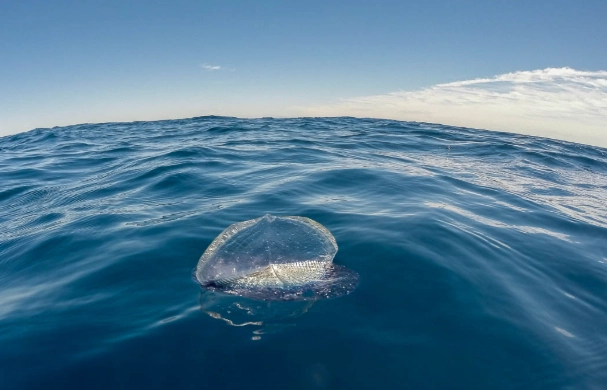
Mythbuster Corner
Myth: By-the-wind sailors sting like jellyfish.
Reality: Their nematocysts are designed for tiny plankton. For almost all people, they feel like nothing. At most, you might feel a slight tingle if you have very sensitive skin or rub it on a soft spot like your wrist. The fear is way overblown.
Myth: A beach covered in them is a sign of pollution or ecosystem collapse.
Reality: Mass strandings are a natural, cyclical phenomenon. They indicate specific wind and current conditions (often strong onshore winds after a period of offshore breezes that concentrated them) and a productive ocean that supported a large population. It's a sign of life, not death—though it does end tragically for that particular group of sailors.
Why Do Millions Wash Ashore? The Science of Strandings
Seeing a by-the-wind sailor armada on the beach is a spectacle. It happens when sustained, strong winds blow consistently toward the shore for days. These creatures live at the very interface of air and water, the top few millimeters. They have zero swimming ability. So if the wind blows shoreward for long enough, everything in its path gets deposited.
Spring is a common time for these events on the US West Coast, for example, when prevailing wind patterns shift. It's not that there are suddenly more of them; it's that the ones always living offshore are finally delivered to our doorstep by atmospheric express mail. The World Register of Marine Species (WoRMS) tracks distribution records, and these strandings provide valuable citizen science data about their range and population dynamics.
The aftermath is a bit grim. The colonies die quickly out of water. Their blue color fades to a dull, opaque white or silvery-gray as they dry out. They then either desiccate into crisp, cellophane-like flakes or get broken down by sand hoppers and other beach cleaners. The smell during a big die-off can be... noticeable. Not rotten, but distinctly briny and organic.
Their Role in the Ocean (And On the Beach)
In the open ocean, by-the-wind sailors are both predator and prey. They are efficient grazers of plankton, helping to cycle nutrients. In turn, they are a crucial food source. Some specialized predators have evolved to eat them despite the stinging cells.
- The Ocean Sunfish (Mola mola): A famous predator that seems to relish them.
- The Purple Sea Snail (Janthina janthina): This incredible creature actually floats upside-down using a raft of bubbles and hunts velellas and other drifters.
- Blue Sea Slugs (Glaucus atlanticus): The "blue dragon" sea slug feeds on velellas and other cnidarians, storing their stinging cells for its own defense.
When they strand, this nutrient load is transferred from the ocean to the coastal ecosystem. They become a feast for shorebirds, crabs, and insects, essentially fertilizing the beach with oceanic nitrogen and carbon. So, a stranding event, while an endpoint for the sailors, is a temporary boom for the intertidal food web.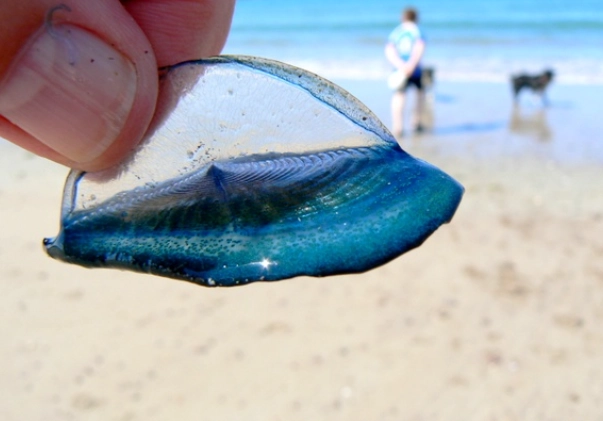
What to Do If You Find One (A Practical Guide)
So you're on the beach and you see these little blue wonders. Here's a simple, ethical guide.
I like to just look at them. The intricacy of that sail, the deep blue color, the realization of what it is—it's a moment of connection with the open ocean, delivered to your feet. It’s a reminder of how much life exists out there, drifting just beyond the horizon, living a life we can barely imagine.
The Big Picture: Drifters in a Changing Sea
Creatures like the by-the-wind sailor are more than just curiosities. They are integral components of the neuston, the community of organisms that live at the ocean's surface. This layer is critical but poorly understood. It's a nursery for fish, a highway for dispersal, and a unique ecosystem facing threats from plastic pollution (which they can mistake for habitat or food) and changing climates.
Their complete dependence on wind also makes them a kind of biological barometer. Studying strandings can tell us about shifts in atmospheric circulation. In that sense, these little blue sailors are messengers, telling us what's happening far out at sea. We just have to learn to read their arrival.
They embody a certain kind of resilience through simplicity and numbers. They don't fight the current or the wind; they are designed to go with it, with a built-in genetic gamble to ensure some of them always survive. In our human world of constant struggle and control, there's a strange lesson in that. Sometimes, you just have to put up your sail and see where the wind takes you.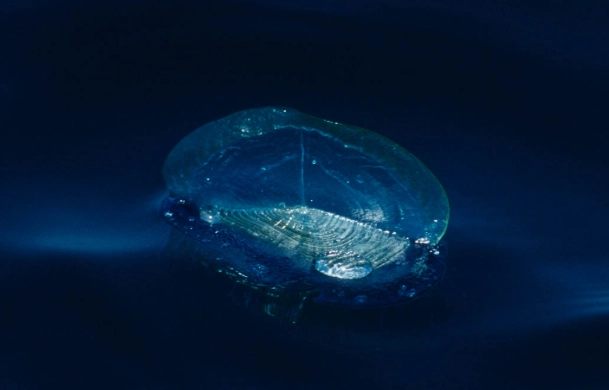
Next time you're on a beach, keep an eye on the tide line. That flash of blue might be more than trash. It might be a tiny voyager, at the end of an epic, wind-driven journey, offering you a glimpse into the vast, drifting life of the open ocean.

Comments
Leave a Comment