Quick Navigation
- The Built-In Climbing Kit: Anatomy of a Jump
- How High and How Far? Decoding the Jump Itself
- Not Just a Solo Act: Behavior and Social Jumping
- Why Evolve This Way? The Survival Trade-Offs
- Klipspringer Jumping vs. Other Animal Athletes
- Conservation Status: Are Their Cliffs Safe?
- Your Klipspringer Jumping Questions, Answered
- Final Thoughts: More Than Just a Jump
I remember the first time I saw a klipspringer. It wasn't in some fancy documentary, but on a rocky hillside in South Africa. One moment the slope was bare, just grey rock and scrub. The next, this compact, sturdy little antelope was standing on a boulder no bigger than a dinner plate, looking down at me with what I swear was amusement. Then, with a flick of its hind legs, it was gone – not running, but klipspringer jumping from one impossibly small foothold to another, up a face I wouldn't attempt with climbing gear. It left me speechless. How does an animal that weighs about as much as a large dog perform such acrobatics on near-vertical terrain?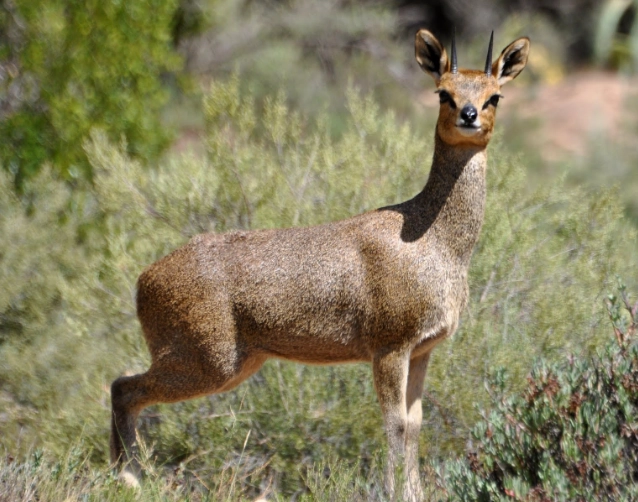
That question stuck with me. The klipspringer (Oreotragus oreotragus) is a master of its environment in a way few animals are. Its entire existence is built around vertical mobility. We hear about mountain goats, sure. But the klipspringer operates on a different scale of precision. It's less about brute strength and more about perfect balance, like a ballet dancer on pointe shoes, if those shoes were designed for granite.
This isn't just a cool party fact. Understanding klipspringer jumping is a window into evolutionary problem-solving. It's about how life adapts to fill the most challenging niches. For anyone fascinated by animal behavior, biomechanics, or just the raw wonder of nature, the klipspringer is a perfect case study. So, let's break it down. What exactly makes this little antelope the parkour champion of the African savannah and highlands?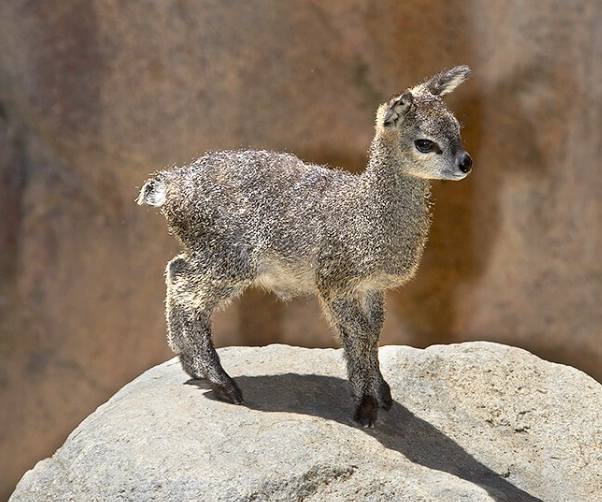
The Built-In Climbing Kit: Anatomy of a Jump
You can't talk about the jump without first looking at the tools. The klipspringer's body is a masterpiece of specialized adaptation. It's not a generalist; it's a specialist tool honed over millennia for one job: stable mobility on rocks.
The Famous Hooves: More Than Just Tip-Toes
Everyone mentions the hooves. They're the klipspringer's signature feature. But describing them as "standing on the tips of its hooves" is a bit of an oversimplification that misses the brilliance.
The hoof is structured like a short, blunt cylinder. The secret is in the internal anatomy and the keratinous pad. The central two toes bear the weight, and the hoof's structure is incredibly dense and shock-absorbent. It acts like a natural climbing shoe rubber, conforming slightly to micro-irregularities in the rock surface. This provides grip that a hard, flat hoof simply couldn't.
I've read some accounts that make it sound like they're on stilts. That's not right either. The posture is upright, yes, but it's a stable, powerful column. The bones of the lower leg are aligned almost vertically, creating a direct line of force from the hip to the contact point. This alignment is crucial for efficient klipspringer jumping – it allows for powerful extension straight down through the hoof, maximizing push-off force.
Center of Gravity and the "Boulder" Body
Look at a klipspringer's silhouette. It's not sleek like an impala or tall like a kudu. It's compact, almost barrel-shaped, with a short neck and relatively short legs (though they don't feel short when you see them propel the animal). This compactness is key. It keeps the animal's center of gravity low and centralized, right over those pivotal hooves.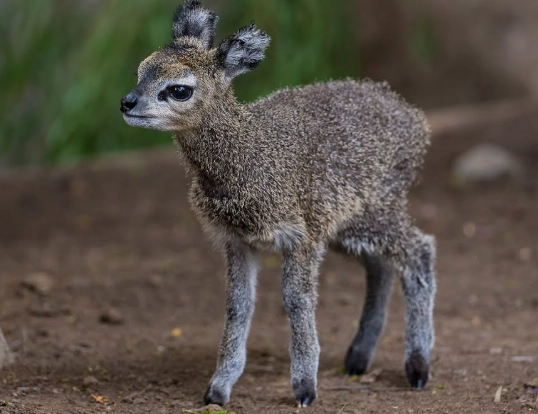
A high center of gravity is the enemy of balance on slopes. Think of a tall person versus a squat person on a rocking boat. The klipspringer's build is inherently stable. This low center of gravity allows for rapid changes in direction and secure landings even when the footing is less than ideal. The thick, coarse coat isn't just for show either – it provides padding against bumps and scrapes during inevitable contact with the rock.
Muscle Power: The Engine Room
All that stability and specialized footing would be useless without an engine. The klipspringer's hindquarters are disproportionately powerful. The muscles there – the gluteals, hamstrings, and calf muscles – are dense and built for explosive contraction. A klipspringer jump isn't a long, soaring leap like a gazelle's. It's a rapid, piston-like thrust. The power comes from a deep crouch followed by an ultra-fast extension of the hind legs, driving the body upward and forward with remarkable accuracy.
The body is the blueprint. The hooves are the interface. The muscles are the motor.
How High and How Far? Decoding the Jump Itself
So, what are the actual stats? This is where a lot of online info gets fuzzy, repeating vague numbers without context. Based on observed behavior and studies of similar-sized animals with specialized locomotion, we can get a realistic picture.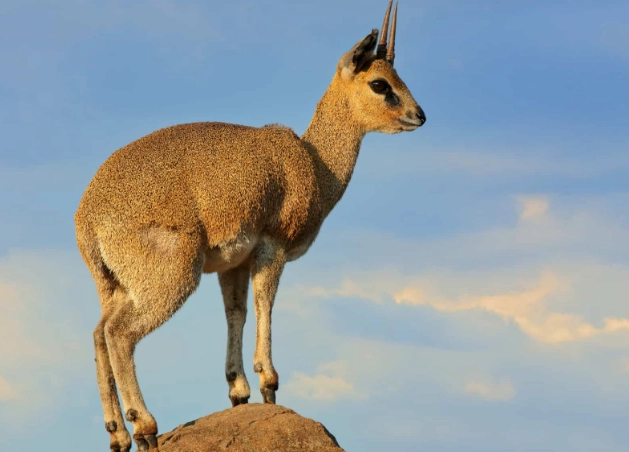
Klipspringer jumping is primarily about precision and access, not setting height or distance records. Their jumps are typically short-range.
- Vertical Jump: They can easily spring onto rocks and ledges 1.5 to 2 meters (5 to 6.5 feet) high from a standing start. This is the most common and critical jump for navigating tiered rock faces.
- Horizontal/Downward Jump: They are masters of gap-crossing. Leaping across crevices or from a higher rock to a lower one 3-4 meters (10-13 feet) away is well within their capability. The downward jump is particularly clever, as it allows them to descend cliffs quickly by hopping down tiered platforms.
- Inclined Jump: This is their specialty – jumping upward at an angle to a higher point on a slope. This combines both vertical and horizontal displacement and is the essence of their climbing strategy.
It's not the raw numbers that impress; it's the context. They achieve this on surfaces that are often smooth, sloping, or crumbly. A human athlete could likely jump higher on a flat, sprung floor. But try doing it onto a sloping, wet kitchen countertop. That's the klipspringer's everyday reality.
Their landing strategy is also unique. They don't "crash" land. They absorb the impact through their columnar legs and shock-absorbing hooves, often immediately going into a slight crouch to re-establish balance. The front hooves touch down with precision, ready to grip. It's a single, fluid motion: launch, trajectory adjustment, touch-down, stabilize.
Not Just a Solo Act: Behavior and Social Jumping
Klipspringers are almost always seen in pairs – a bonded male and female that mate for life. This has a huge impact on their behavior, including their jumping.
They are territorial and use prominent rocks as lookout points. You'll often see one member of a pair standing sentinel on a high boulder while the other feeds. This sentinel behavior is a key anti-predator strategy. Their camouflage is excellent (their grizzled coat mimics lichen-covered rock), but their eyesight is sharp. From a vantage point, they can spot danger from far away.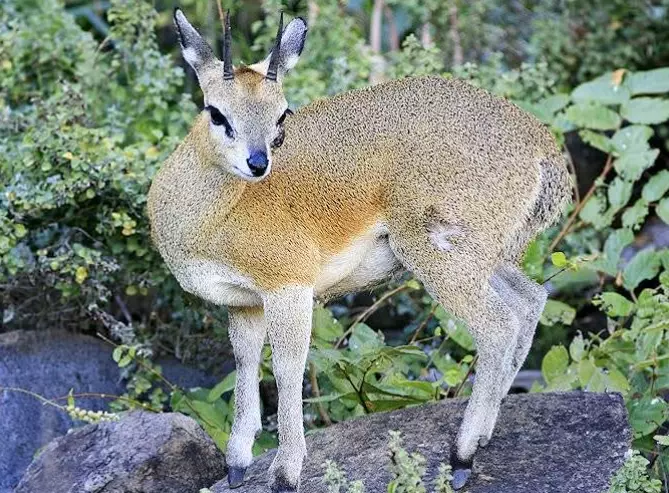
Now, how does klipspringer jumping fit into the social structure?
- Coordinated Flight: When threatened, the sentinel will give a sharp, whistling alarm call. The pair then flees together. Their escape route is almost never a flat run. It's a coordinated series of jumps, following a pre-learned pathway through their rocky territory that they know is navigable. They leap in sequence, one often following the other's exact path, exploiting footholds they've used a hundred times before.
- Territorial Displays: Jumping can also be part of displays. A male may make a series of brisk, exaggerated jumps onto prominent rocks to signal his presence and fitness to rivals or to his mate. It's a way of showing off his mastery of the terrain.
- Teaching the Young: A single lamb (rarely twins) is born each year. While the lamb is remarkably precocious and can follow its mother within a day or two, learning the art of jumping takes time. It learns by following, mimicking the angles and take-off points its parents use. An unskilled jump in this environment can be fatal, so this apprenticeship is critical.
Why Evolve This Way? The Survival Trade-Offs
Evolution is about trade-offs. The klipspringer's incredible specialization for rocky outcrops comes at a cost. Understanding these trade-offs shows why they aren't everywhere.
The Advantages (The "Pros" of being a rock specialist):
- Predator Evasion: This is the big one. They inhabit terrain that most of their major predators – lions, leopards, hyenas, wild dogs – find difficult or impossible to hunt in effectively. A leopard might follow them somewhat, but a lion won't bother. Their primary predator in rocky areas is likely the agile leopard or the martial eagle, but even these have a tough time in the klipspringer's most vertical haunts.
- Reduced Competition: Few other large herbivores can efficiently exploit the sparse vegetation found on cliffs and rocky slopes. They have a food niche largely to themselves.
- Excellent Vantage Points: As mentioned, their habitat provides natural watchtowers.
The Disadvantages (The "Cons" they live with):
- Limited Range: They are utterly dependent on rocky terrain. They cannot thrive in open plains, dense forests, or swampy areas. This makes their populations naturally fragmented and island-like.
- Vulnerability on Flat Ground: On open, flat ground, a klipspringer is relatively slow and clumsy compared to other antelope. Its upright posture and point-load hooves are inefficient for sustained speed on soft soil. This is why they rarely venture far from the safety of rocks.
- Specialized Diet: They are browsers, eating leaves, shoots, fruits, and flowers from hardy shrubs and trees that grow in rocky areas. They are not grazers. This limits their food options, though what is there is usually theirs alone.
- Reproductive Rate: Having a single offspring per year is a slow strategy, making populations slower to recover from declines.
When you weigh it up, the trade-off is clear. They sacrificed general mobility and reproductive speed for supreme safety and reduced competition in a specific, harsh habitat. It's a strategy that has worked for millions of years.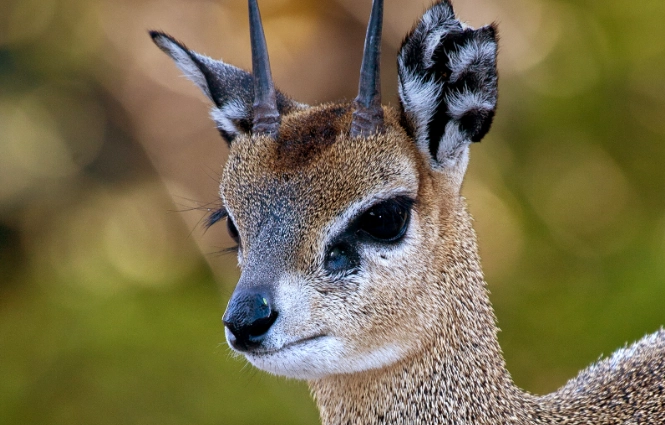
Klipspringer Jumping vs. Other Animal Athletes
To really appreciate the klipspringer's niche, it helps to compare. Many animals jump, but for different reasons and with different mechanics.
| Animal | Jump Type / Purpose | Key Adaptation | How it Differs from Klipspringer Jumping |
|---|---|---|---|
| Klipspringer | Precision climbing on irregular, steep rock. | Columnar legs, shock-absorbing tip-toe hooves, low center of gravity. | Focused on accuracy, stability on slopes, and short-range explosive power from a standstill. |
| Springbok / Impala | High, soaring "pronking" or stotting to signal fitness and confuse predators on open ground. | Long, slender legs with great leverage, lightweight body. | Designed for height/distance on flat, even terrain. Landing impact is absorbed on flat, broad hooves suited to soil. |
| Mountain Goat | Power climbing on steep, often snowy/grassy mountain slopes. | Cloven hooves with rough, rubbery pads and dewclaws for grip, incredibly strong shoulders. | More about sustained climbing and traction on a variety of surfaces (dirt, snow, rock). Less about pinpoint accuracy on small holds, more about powerful adhesion. |
| Tree Kangaroo | Arboreal leaping between tree branches. | Strong forelimbs for grasping, long tail for balance, powerful hind legs. | Jumping to/from flexible, often moving perches (branches). Requires grasping ability, which klipspringers lack. |
| Flea | Extreme acceleration for escape. | Resilin protein (a super-elastic polymer) in legs acting like a catapult. | A pure power-to-weight champion for raw acceleration, with no concern for controlled landing on a specific point. |
The table makes it obvious. The klipspringer's adaptations are a unique suite for a very specific problem: three-dimensional travel on complex, hard, mineral surfaces. They're the rock climbers of the antelope world, while springboks are the high jumpers and mountain goats are the all-terrain mountaineers.
Conservation Status: Are Their Cliffs Safe?
This is the part that worries me. The klipspringer is currently listed as Least Concern on the IUCN Red List, which sounds good. Their total population is estimated to be stable. But "Least Concern" at a global level can mask local threats and the inherent fragility of their niche.
Their primary threat isn't direct hunting (though they are hunted in some places), but habitat fragmentation and disturbance.
- Human Development: Quarrying, road construction through rocky areas, and expanding agriculture can isolate populations. A klipspringer population trapped on a single, small rocky outcrop surrounded by farmland is a population at risk. They can't cross the open land to find mates from other groups, leading to inbreeding.
- Livestock Competition: Goats and sheep are often grazed in marginal areas, including rocky slopes. They compete directly with klipspringers for food and can degrade the vegetation.
- Disturbance from Tourism: This is a tricky one. Responsible wildlife viewing is great. But I've seen off-road vehicles chasing animals for a photo, or hikers and climbers inadvertently disturbing critical habitats. A klipspringer forced to flee repeatedly burns precious energy and is stressed.
- Climate Change: Changes in rainfall patterns can alter the vegetation composition on their rocky homes, potentially reducing food availability.
The good news? Because they rely on specific, often rugged terrain, well-placed protected areas (like national parks and reserves that include kopjes and cliffs) can be highly effective for their conservation. They are also present in many such areas across eastern and southern Africa. Organizations focused on landscape connectivity are crucial to ensure isolated groups don't become genetically cut off.
Their future hinges on us valuing those "useless" rocky hillsides as critical wildlife habitat.
Your Klipspringer Jumping Questions, Answered
I've gotten a lot of questions from readers over the years about these animals. Here are some of the most common ones, based on what people are actually searching for.
- Serengeti National Park (Tanzania) & Masai Mara (Kenya): The famous kopjes are classic klipspringer habitat.
- Matobo Hills (Zimbabwe): A stunning landscape of granite domes – klipspringer paradise.
- Drakensberg Mountains (South Africa/Lesotho): Higher altitude populations.
- Ethiopian Highlands: Home to a distinct subspecies.
Look for them early morning or late afternoon, often standing motionless on a prominent rock. Patience is key!
Final Thoughts: More Than Just a Jump
Watching a klipspringer navigate its world is humbling. It's a reminder that evolution isn't just about big teeth and fast runs. It's about perfect, elegant solutions to environmental puzzles. The klipspringer jumping phenomenon is a holistic package: anatomy, physiology, behavior, and learned skill all wrapped into one.
That compact body, those strange hooves, the powerful thrust, the unwavering balance – it's all in service of life on the edge, literally. They turn what looks like an inhospitable jumble of rocks into a safe home, a pantry, and a playground. In an era where we're fascinated by human parkour and free-climbing, we've had a living, breathing master of the craft living alongside us all along.
So next time you see a photo of a rocky African landscape, look a little closer. You might just spot a small, sturdy silhouette standing perfectly balanced on a pinnacle, a quiet testament to millions of years of perfecting the jump.


Comments
Leave a Comment