If you've ever seen a violin crab scuttling across the sand or clinging to a piece of live rock, the first thing that probably struck you was its size. Or rather, its lack of it. These are tiny creatures. But "tiny" is vague. When you're trying to identify one, set up a suitable tank, or simply satisfy your curiosity, you need hard numbers. So, how big do violin crabs actually get? The answer is more nuanced than a single measurement, and getting it wrong is a common pitfall for new hobbyists. I've kept these little guys for years, and I've seen the same mistakes repeated—people buy tanks that are too large, miss subtle growth signs, or even mistake them for other species because they eyeballed the size. Let's cut through the guesswork. The typical violin crab (Uca spp.) has a carapace (main body shell) width ranging from a mere 10 millimeters (0.4 inches) to about 25 millimeters (1 inch). That's smaller than a quarter. Their legspan, however, tells a different story, often doubling or tripling their apparent size. This guide will break down exactly what those numbers mean for you as an observer or aquarist.
Quick Navigation
Understanding Violin Crab Size and Body Structure
You can't talk about violin crab size without understanding what part you're measuring. Most online sources throw out a number like "1 inch" without context, which is borderline useless. Are they talking about body width, length, or legspan? For crabs, the scientific standard is carapace width (CW). This is the measurement across the widest part of the main body shell, from one side to the other, excluding the legs.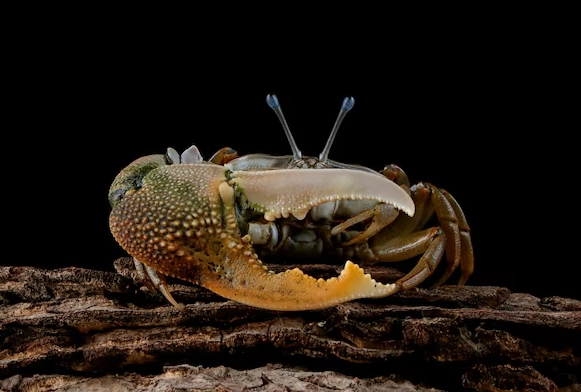
Key Takeaway: When someone says a crab is "1 inch," always ask: Is that carapace width or total legspan? The difference is massive. A crab with a 1-inch carapace can have a total legspan of 3-4 inches, completely changing its spatial needs.
For violin crabs, or fiddler crabs, the carapace is roughly rectangular or square-ish. Males have that one massively enlarged claw (the "violin" or "fiddle") that can sometimes appear as large as their entire body, but this is not included in the carapace width measurement. Females have two small, equal-sized claws. The size range isn't arbitrary; it's closely tied to species, sex, and habitat. The commonly kept Uca pugnax (Atlantic marsh fiddler) tends to be on the larger end of the spectrum, while species like Uca lactea are often smaller.
| Measurement Type | Typical Range | What It Means For You |
|---|---|---|
| Carapace Width (CW) | 10 – 25 mm (0.4 – 1.0 in) | The core body size. Determines hiding spot dimensions and general species ID. |
| Total Legspan (Tip to Tip) | 30 – 75 mm (1.2 – 3.0 in) | The "footprint" of the crab. Crucial for determining minimum tank floor space. |
| Major Claw Length (Males only) | Can equal or exceed carapace width | Adds significant bulk. Needs space to maneuver without damage. |
I remember setting up my first fiddler crab tank. I read "1 inch crab" and got a 2.5-gallon tank, thinking it was plenty. I didn't account for the legspan or the fact that they need both land and water areas. The tank felt cramped immediately. The crabs were constantly bumping into each other and the glass. That was my first lesson in looking beyond the basic carapace width number.
How to Measure Your Violin Crab Accurately (Without Stressing It Out)
You want to know how big your crab is. Trying to hold a wiggly, pinch-happy crab against a ruler is a bad idea for both of you. Here's a method I've refined that minimizes stress and gets you a reliable carapace width measurement.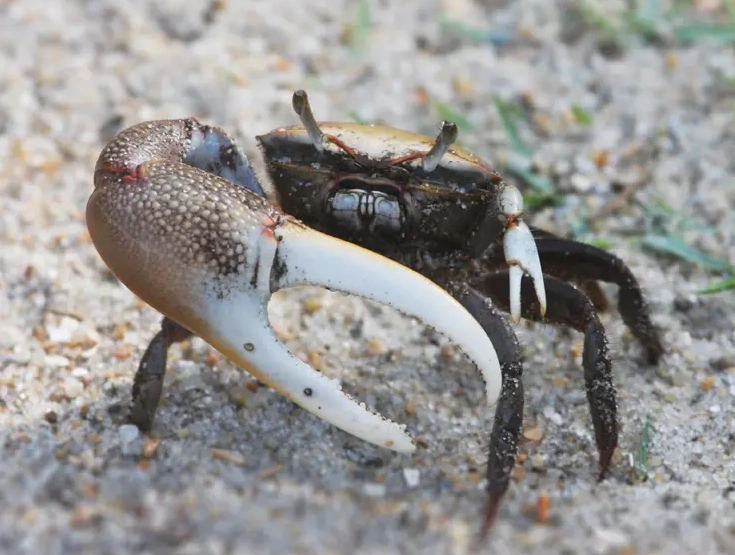
The Photographic Measurement Method
This is the gold standard for hobbyists. You'll need your crab, a tank with a clear front, and a reference object of known size placed on the same plane as the crab. A small coin (like a dime or penny) works perfectly.
- Prepare the Scene: Place the reference coin flat against the front glass, inside the tank if possible, or right up against the outside if your crab is near the front.
- Wait for the Pose: Be patient. Wait until your crab is calm, facing sideways relative to the glass, and on the same level as the coin. A top-down view works if the crab is under shallow water or on land, but a side view against the glass is often clearer.
- Snap the Picture: Take a clear photo with your phone or camera. Get as close as you can without disturbing the crab.
- Analyze Later: On your computer or phone, use any basic photo editor with measurement tools, or simply compare visually. If a dime (18mm) is in the photo, you can estimate the crab's carapace width relative to it.
The most common mistake I see? People measure from the tip of one walking leg to the tip of the opposite leg and call that the "crab's size." That's the legspan, which is useful for tank sizing, but it's not the standard biological measurement used for identification or growth tracking. Always aim for carapace width.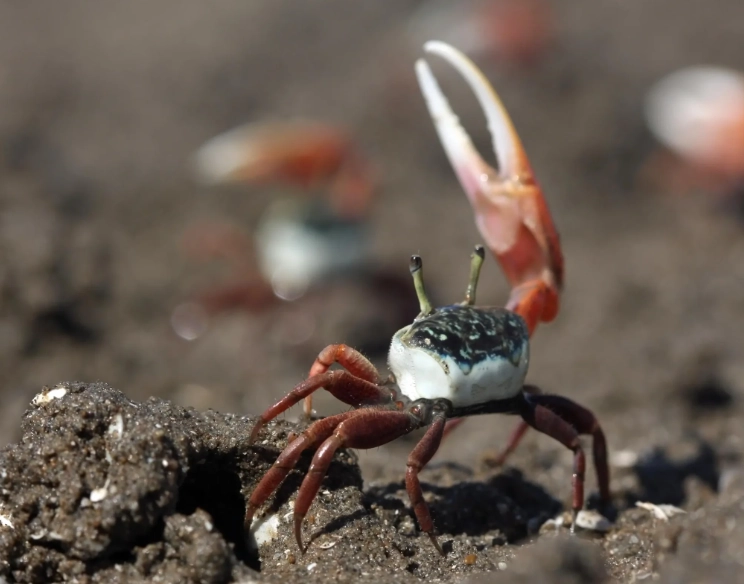
Why Their Small Size is a Big Deal: Ecology and Adaptation
Violin crabs aren't small by accident. Their size is a direct ticket to a specific ecological niche. In the wild, they inhabit intertidal zones, mudflats, and mangrove swamps—environments that are harsh, dynamic, and crowded. Being small allows them to:
- Exploit Micro-Habitats: They can burrow into narrow, deep tunnels in the mud to escape predators, heat, and desiccation during low tide. A larger crab would need exponentially more energy to dig and maintain such a burrow.
- Access Limited Food Sources: They primarily eat detritus, bacteria, and algae from the surface of the sediment. Their small size means they can forage efficiently over a large area relative to their body mass, picking up microscopic food particles larger animals would ignore.
- Reduce Predation Risk: Their compact size lets them hide quickly in burrows or under debris. That iconic large claw on the male? It's used more for signaling and fighting rival males than for defense against large predators. When a bird comes, they run and hide; they don't stand and fight.
In your tank, this evolutionary history translates into specific needs. A deep, stable substrate for burrowing is non-negotiable. It's not just a "nice-to-have"; it's a core behavioral requirement tied directly to their small, vulnerable physique. I've tried tanks with shallow sand, and the crabs were visibly stressed, constantly trying to dig and failing to create a secure hide.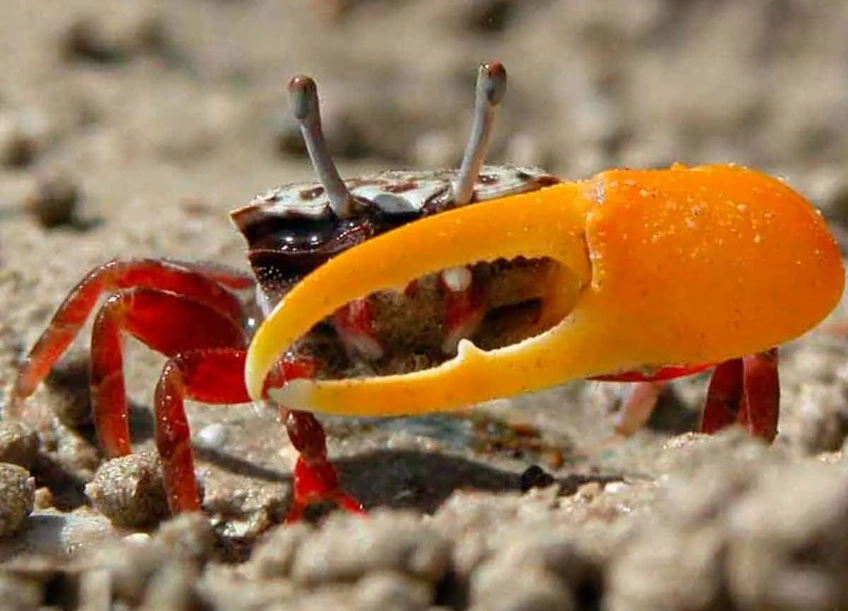
Tank Setup and Care Dictated by Size
Forget the old "one gallon per inch of crab" rule. It's meaningless for creatures that need complex terrain. Your setup should be guided by their dimensions and natural behaviors.
Minimum Tank Dimensions
For a small group of 2-3 violin crabs, I wouldn't go smaller than a 10-gallon tank (20" long). Why? You need to create a distinct gradient from a dry land area to a brackish water area. The length is more important than height. Based on their legspan, a tank this size gives each crab enough room to establish a small territory, forage, and retreat without constant conflict.
Substrate Depth and Composition
This is where their carapace width comes in. Your substrate (sand/mud mix) needs to be at least twice as deep as your largest crab's carapace is wide. If your crab has a 20mm (0.8") carapace, aim for 4-5 inches (10-13 cm) of substrate. This allows them to create a proper, collapsing burrow that feels secure. Coconut fiber mixed with play sand or aragonite sand works well—it needs to hold a tunnel shape when damp.
Molting and Size Increases
Violin crabs grow by molting—shedding their old, hard exoskeleton and expanding a new, soft one before it hardens. Each successful molt can result in a 20-30% increase in carapace width. A 15mm crab could become an 18-20mm crab after one molt. This is a critical, vulnerable period. They will hide for days or even weeks. You must provide multiple hiding spots (caves, PVC pipes, dense plants) and never remove the old exoskeleton immediately. They eat it to recycle the minerals needed to harden their new shell.
If your crab seems to have disappeared into the substrate for an extended time, don't panic and start digging. You'll almost certainly disturb a molting crab and likely kill it. Patience is key.
Your Violin Crab Size Questions Answered
My violin crab looks smaller than the size ranges I see online. Is it stunted or unhealthy?
Not necessarily. First, ensure you're measuring carapace width correctly. Second, remember the range includes adults. You might have a juvenile that hasn't reached its full size yet. Third, and this is crucial, captive crabs in suboptimal conditions (wrong salinity, poor diet, insufficient minerals) can have failed or partial molts, leading to smaller adult size. If your crab is active, eating, and burrowing, it's probably just a younger or naturally smaller specimen. Chronic stunting from poor care usually comes with other visible signs like lethargy or a dull shell.
How can I tell if my crab is a full-grown adult or a juvenile based on size?
It's tricky without knowing the exact species. For common pet-trade fiddlers, a carapace width over 20mm (0.8 in) is usually indicative of an adult. Juveniles are often below 15mm. Look for other clues: Adult males will have a distinctly enlarged claw that is markedly larger than the other. In females and juveniles, the claws are equal and tiny. The overall proportions of an adult also look more "filled out" and robust compared to the slightly gangly look of a juvenile.
I want a nano tank. Can a single violin crab live in a 5-gallon tank?
Technically, yes, a single crab could physically fit. But it's not ideal, and here's the non-consensus view: it's often more work to maintain stable conditions in a 5-gallon tank than in a 10-gallon. Water parameters (especially brackish salinity) can swing rapidly in tiny volumes, causing stress. Furthermore, these are social creatures; they do better in small groups where they can exhibit natural behaviors like mild territorial displays. A lone crab in a bare 5-gallon tank may seem fine but often shows less natural activity. If you insist on a 5-gallon, you must be meticulous with water changes, provide a deep substrate, and include ample enrichment. Personally, I find a 10-gallon "long" tank a much better starting point for animal welfare and your own success.
Does the size of the male's big claw affect how I should measure or house him?
Absolutely. When measuring carapace width, ignore the big claw. It's an appendage. However, for tank layout, you must consider its sweep. A male waving or feeding needs extra horizontal clearance so he doesn't constantly bang that precious claw against the glass or decorations. Provide open space in the front of the tank. Also, that claw is heavy. Ensure he has easy access to elevated dry areas so he can rest without being partially submerged all the time.
Understanding violin crab size is more than memorizing a number. It's about connecting that measurement to their biology, their needs in your tank, and their fascinating way of life. By focusing on accurate carapace width and respecting what that small size enables, you'll create a much better environment for these captivating little crustaceans. For further scientific classification and details, resources like the Smithsonian Institution's online databases can be invaluable for species-specific data.



Comments
Leave a Comment