Walking along a West Coast beach in spring, you might find the sand carpeted in thousands of tiny, electric-blue, sailboat-like creatures. They look like plastic toys, but they're very much alive. This is a Velella velella mass stranding event, and the creature is famously known as the By the Wind Sailor jellyfish. It's not a true jellyfish, it barely stings, and its entire life is dictated by a tiny, rigid sail on its back. Let's get into what makes this little drifter so fascinating and what you need to know if you encounter one.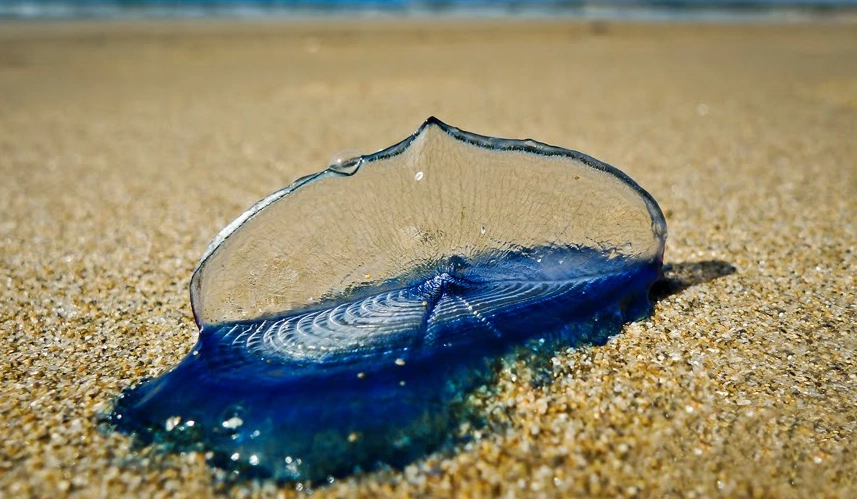
In this article, you'll learn:
What Exactly Is a By the Wind Sailor?
First, a crucial correction most blogs get wrong: the By the Wind Sailor (Velella velella) is not a jellyfish. It's a hydrozoan, a relative of the Portuguese man o' war. It's a colonial organism, meaning each little "sailboat" is made up of a cooperative of many tiny, specialized polyps living together on a chitinous float.
The most obvious feature is its sail. This isn't a floppy membrane; it's a stiff, vertical, triangular plate made of chitin. The sail is set diagonally across the oval float (which is usually 3-7 cm long). This diagonal orientation is the key to its entire existence.
Here's the brilliant, simple mechanics: the sail catches the wind. Velella can't swim. They are passive drifters, or pleuston, living at the very surface of the ocean. The wind direction determines everything. Their sails are chiral, meaning some individuals have sails oriented clockwise, others counter-clockwise. In the North Pacific, most have sails oriented to the left. This theoretically helps populations spread and not all get blown ashore at once, though spring winds often overwhelm this adaptation.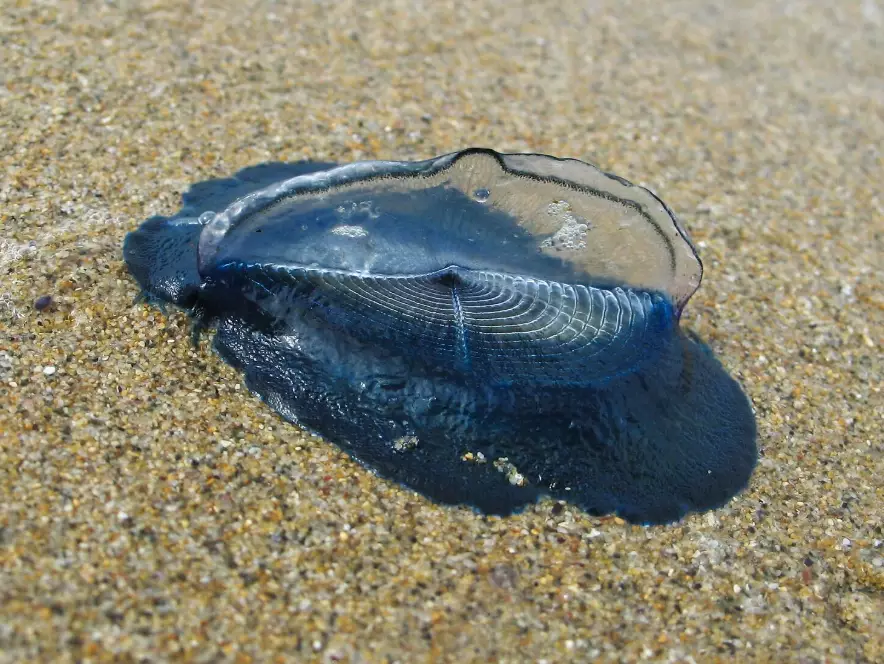
Do By the Wind Sailors Sting Humans? The Truth About Safety
This is the number one concern for beachgoers, especially parents. The answer brings relief: their sting is negligible for humans.
Velella possess stinging cells (nematocysts) to capture tiny plankton, their only food. However, these cells are far too weak to penetrate human skin. You can gently pick one up without fear. The sensation, if any, might be a slight stickiness or mild prickling, easily washed off with seawater.
The real danger is misidentification. People hear "jellyfish" and panic, or they confuse Velella with its much more dangerous cousin, the Portuguese man o' war. This confusion leads to unnecessary beach closures and alarm. I've seen entire families flee a beach because someone shouted "jellyfish!" at a harmless Velella bloom.
So, the rule is simple: if it's small, blue, has a rigid sail, and is washing up in the thousands, it's almost certainly a harmless By the Wind Sailor. Still, it's good practice not to rub your eyes after handling any marine creature and to rinse your hands.
Why Mass Strandings Happen: The Science of the Strand
Seeing a million blue sails on the beach is dramatic. It's not a sign of pollution or disaster, but a natural, wind-driven event.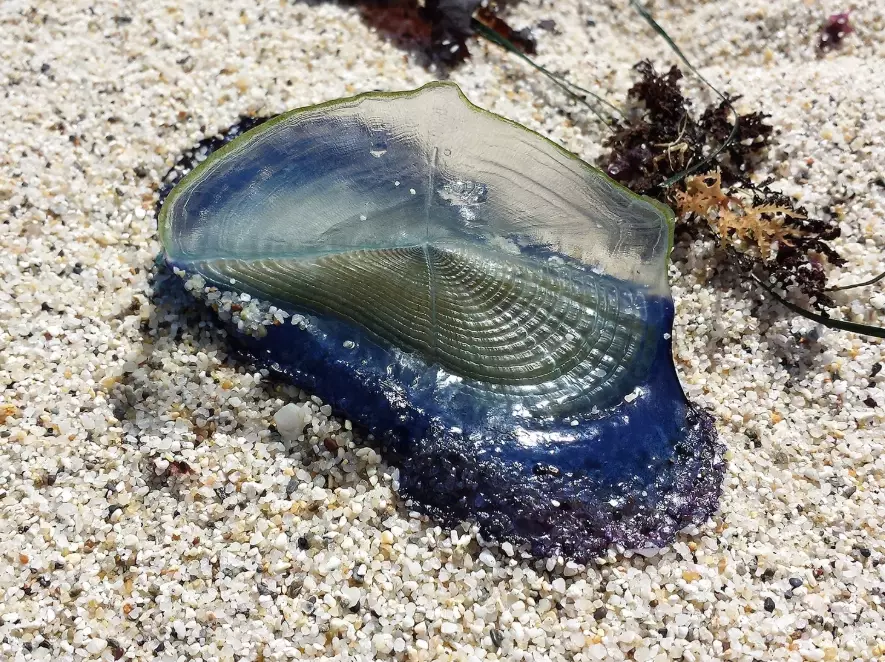
Velella live far offshore in the open ocean. In spring, strong, persistent onshore winds (like the "spring transition" winds on the U.S. West Coast) develop. These winds push surface water—and everything floating on it—toward the coast. A vast aggregation, or "smack," of Velella gets herded inexorably toward the beach over days or weeks.
Once ashore, they die quickly. They can't right themselves or get back to the water. The result is that striking blue line at the high tide mark. The scale can be staggering. According to a study cited in Nature, a single mass stranding can involve billions of individuals along hundreds of miles of coastline.
These events are a bonanza for shorebirds and other scavengers, and as the Velella decompose, they release nutrients back into the coastal ecosystem. It's a cyclical, if somewhat smelly, part of coastal ecology.
Could Climate Change Affect Velella Blooms?
It's a question researchers are asking. Warmer ocean temperatures might expand their range or alter the timing of blooms. Changes in wind patterns, a key driver of strandings, are also a climate factor. While not a major conservation concern, Velella serve as a useful indicator species for studying how ocean surface communities respond to shifting conditions. Citizen science reports of strandings are actually valuable data for marine scientists.
Where and When to See Them: A Beachcomber's Guide
If you want to witness this phenomenon, you need to be in the right place at the right time. It's not guaranteed, but these parameters stack the odds in your favor.
Prime Locations: The classic hotspots are beaches facing the prevailing westerly winds in the North Pacific. This includes the entire U.S. West Coast from Washington to California. I've seen the most impressive strandings on wide, sandy beaches like Monterey's Del Monte Beach in California or Long Beach in Washington. They also occur, less frequently, in the North Atlantic and Mediterranean.
Prime Time: Spring is king, typically March through June. This follows the seasonal strengthening of onshore winds. Fall can sometimes see smaller events. The best time to look is right after a few days of strong wind, especially following a storm, and during a morning low tide when the wrack line is exposed.
| Location | Typical Season | What to Look For |
|---|---|---|
| California Coast (e.g., Monterey, San Diego) | April - June | Blue line at high tide, often after NW winds. |
| Oregon & Washington Coast | May - July | Large masses on sandy beaches following spring storms. |
| British Columbia, Canada | May - August | Less frequent, but occurs on west-facing Vancouver Island shores. |
| UK & Irish Coasts (Atlantic side) | April - September | Sporadic, often driven by Gulf Stream currents and winds. |
Check local marine biology groups or beach reporting forums before you go. A post saying "Velella are here!" is your cue.
Telling Them Apart: Velella vs. Lookalikes
Mistaking Velella for something else is easy. Here’s a quick breakdown to prevent confusion.
The Portuguese Man O' War (Physalia physalia): This is the big one. Man o' war are larger (float up to 30 cm), have a pink or purple gas-filled bladder (not a flat blue float), and a sail that is an inflatable crest, not a rigid plate. Critically, their trailing tentacles deliver an intensely painful, dangerous sting. They rarely strand in the massive numbers Velella do. If you see a large, colorful, inflated bladder with long threads, keep your distance.
Blue Buttons (Porpita porpita): Another hydrozoan cousin. These are smaller, round, flat, and solid blue like a coin, with no distinct sail. They sometimes strand alongside Velella but are easily distinguished by their shape.
True Jellyfish (like Moon Jellies): Moon jellies are translucent white with a four-leaf clover pattern, pulsate, and have no hard parts or sail. They are fundamentally different in form and feel.
Your Questions, Answered
I touched a bunch of By the Wind Sailors and now my skin is itchy. What's happening?
Can I keep a dried By the Wind Sailor as a souvenir?
Why do I only see them some years and not others?
My dog ate a dried Velella on the beach. Should I be worried?
Finding a beach transformed by thousands of By the Wind Sailors is a reminder of the open ocean's rhythms playing out on our doorstep. They are harmless, fascinating, and a testament to a life spent entirely at the whim of the breeze. Next time you see that blue line on the sand, you'll know you're looking at one of the ocean's most elegant and simple drifters, not a threat, but a temporary visitor from the deep blue.
Comments
Leave a Comment