You're hiking through a dense, misty Hawaiian rainforest, the air thick with the smell of wet earth and blooming ginger. You're not just here for the waterfalls. You're on a mission to spot one of the planet's most whimsical and elusive creatures: the Happy Face Spider (Theridion grallator). I remember my first time searching for them on Kauai. I spent hours scanning leaves, convinced every speck was a spider. Just as I was about to give up, there it was—a tiny, perfect yellow smile beaming up from the underside of a kī (ti) leaf. It felt like finding a secret the forest had kept just for me.
Your Quick Guide to the Happy Face Spider
What Exactly Is the Happy Face Spider?
Let's clear something up right away. The "happy face" isn't a cartoonish drawing. It's a complex, natural pattern of red, black, and sometimes white markings on its pale yellow or white abdomen. The "smile" and "eyes" are formed by these pigmented spots. Scientists call this Theridion grallator, a name far less charming than its appearance.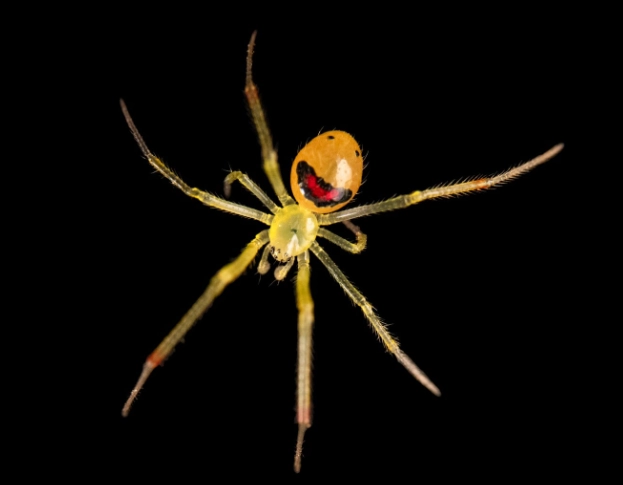
It's tiny. Seriously tiny.
An adult female's body is only about 5 millimeters long—roughly the size of a grain of rice. Males are even smaller. They're not building elaborate webs to catch flies. Instead, they're cobweb weavers, creating messy, irregular tangles of silk on the undersides of broad leaves. They wait patiently for small insects like leafhoppers to blunder in.
Key Fact: The happy face pattern has incredible variety. Some spiders have full, grinning faces. Others might have a frown, a neutral expression, or even abstract patterns. Research from the University of Hawaiʻi suggests this polymorphism might be a defense mechanism, confusing predators who learn to associate a specific pattern with a nasty meal.
They are endemic. This is the most critical word to understand. It means they evolved in Hawaii and are found nowhere else on Earth. They are a unique product of these isolated islands, just like the Hawaiian honeycreepers or the silversword plant.
Where and How to Find the Happy Face Spider in Hawaii
You won't find them on Waikiki Beach. The happy face spider is a creature of the mid- to high-elevation wet forests. Your search needs to be strategic.
Best Locations to Search
Your highest odds are on the oldest islands where these spiders have had the longest time to evolve and establish populations: Kauai, Oahu, Molokai, and Maui. They are reportedly absent from the Big Island (Hawaiʻi), likely because it's geologically too young.
Here’s a practical breakdown of where to look, based on accessible trails and known habitats. Remember, these are wild animals, not exhibits. Seeing one is a privilege, not a guarantee.
| Island | Recommended Area/Trail | Habitat Type | Key Tip & Access Notes |
|---|---|---|---|
| Kauai | Kokeʻe State Park, Alakaʻi Swamp Trail, Pihea Trail | Dense, mossy ohia-lehua and koa forest | The Alakaʻi is prime habitat. Focus on the undersides of māmane and kī leaves. Road access via Waimea Canyon Drive. No entry fee for the state park. |
| Maui | The Nature Conservancy's Waikamoi Preserve (guided hikes only), Hosmer Grove near Haleakalā summit, Polipoli Spring State Recreation Area | Cloud forest, native shrubland | Waikamoi offers guided hikes that provide expert insight. Hosmer Grove is easily accessible off Crater Road. Check for tour availability for Waikamoi in advance. |
| Oahu | Mt. Kaʻala Natural Area Reserve, Pupukea-Paumalu Forest Reserve | Wet mountain forest | Mt. Kaʻala is a challenging, muddy hike requiring a permit. A better bet for casual visitors might be guided eco-tours that visit these remote areas. |
Essential Gear and Mindset
Forget the fancy camera for a second. Your most important tool is patience. You are looking for a grain of rice on the underside of a leaf in a vast, green universe.
Bring a small, bright flashlight or use your phone's light. Angle it across the leaf's underside—the low light can make the pattern pop. A hand lens or a macro lens for your phone is a game-changer. Move slowly. Disturb the vegetation as little as possible.
The best time? Early morning or after a rain, when the spiders might be more active. But honestly, they could be on any leaf, at any time.
Respect is Non-Negotiable: Do not touch the spider. Do not try to move it onto a "better" leaf for a photo. Do not take it home. The oils on your skin can harm it, and removing it from its web is a death sentence. Your goal is to observe without altering its behavior or environment. Stay on marked trails to avoid crushing plants (and possibly spiders) and to prevent spreading invasive plant seeds.
Why the Happy Face Spider's Smile Matters
This isn't just about a cute bug. The happy face spider is a bioindicator. Its presence signals a relatively healthy native forest ecosystem. It's part of a complex food web, controlling tiny insect populations and serving as food for native birds.
Its story is a microcosm of Hawaii's broader ecological tragedy and resilience. As an endemic species, it represents millions of years of unique evolution. When we protect its habitat, we protect countless other unseen species—native snails, insects, plants—that form the foundation of Hawaii's natural heritage.
Organizations like the Hawaii Department of Land and Natural Resources and The Nature Conservancy of Hawaii work to fence out invasive pigs and goats, remove aggressive alien plants, and restore these forests. The spider's survival is directly tied to the success of these efforts.
The Biggest Threats to the Happy Face Spider
The smile is fading, and the reasons are depressingly human.
Habitat Loss: This is the number one threat. Development, agriculture, and deforestation have carved up the native forests they call home.
Invasive Species: This is the silent killer. Rats and ants prey on spiders and their eggs. But the bigger problem is plants. Fast-growing invasive species like strawberry guava, albizia, and ginger choke out the native plants the spiders live on. A forest taken over by ginger is a green desert for native Hawaiian wildlife.
Climate Change: Altered rainfall patterns and rising temperatures could shrink the cool, moist cloud forest zones the spiders require. A drier forest is a hostile forest for Theridion grallator.
It's not listed under the U.S. Endangered Species Act, but that doesn't mean it's safe.
Its limited range and specific needs make it inherently vulnerable. The International Union for Conservation of Nature (IUCN) hasn't assessed it recently, but most biologists will tell you its future is precarious.
How You Can Help Protect Hawaii's Unique Wildlife
You don't need to be a scientist or a millionaire. Your actions as a visitor or resident have a direct impact.
1. Be a Conscious Hiker: We covered this—stay on trails, don't touch wildlife, pack out all trash. Use boot brushes at trailheads to clean your shoes and prevent spreading invasive seeds.
2. Support the Right Organizations: Donate to or volunteer with groups doing the hard, on-the-ground work. Look beyond the big names. Local land trusts and the Pacific Islands Fish and Wildlife Office are critical. Your "entry fee" can be a donation to the maintainers of the forest reserve you're hiking in.
3. Choose Responsible Tourism: Book tours with companies that emphasize conservation, employ local guides, and give back to the community. Ask them about their environmental practices.
4. Spread the Word, Not the Myths: Share photos, but share the context. Tell people it's endemic, tiny, and fragile. Discourage the "collecting" mentality. The goal is appreciation, not possession.
Happy Face Spider FAQ
Finding a happy face spider is more than a tick on a wildlife checklist. It's a connection to the deep, ancient, and wildly creative pulse of Hawaiian evolution. It's proof that wonder still exists in hidden corners. But with that discovery comes responsibility. We have to be the generation that ensures that secret smile in the forest doesn't disappear forever. It starts with looking with your eyes, not your hands, and leaving only footprints that will wash away with the next rain.


Comments
Leave a Comment