Picture this. You're in a submersible, a mile below the surface where sunlight is a forgotten memory. The only light comes from your vehicle's beams, cutting through the endless black. Then, you see it. A slender, jet-black shape, almost invisible except for the faint, eerie glow dangling from its chin like a forbidden lantern. That's your first encounter with a black dragon fish. It's not a monster from a fantasy novel; it's a real, breathing (well, respiring) master of the deep sea, and its survival playbook is wilder than anything Hollywood could dream up.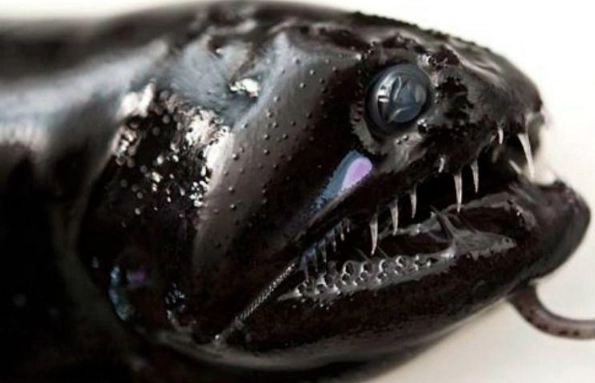
These fish, belonging to the family Stomiidae, are a case study in extreme adaptation. They're not one species but a group, with the Pacific black dragonfish (Idiacanthus antrostomus) being one of the most famous. I've spent years poring over research from places like the Monterey Bay Aquarium Research Institute (MBARI) and talking to deep-sea biologists, and the common thread is awe. We're not looking at a clumsy deep-sea oddity. We're looking at a precision-engineered predator.
What's Inside This Deep Dive?
What Exactly Is a Black Dragon Fish?
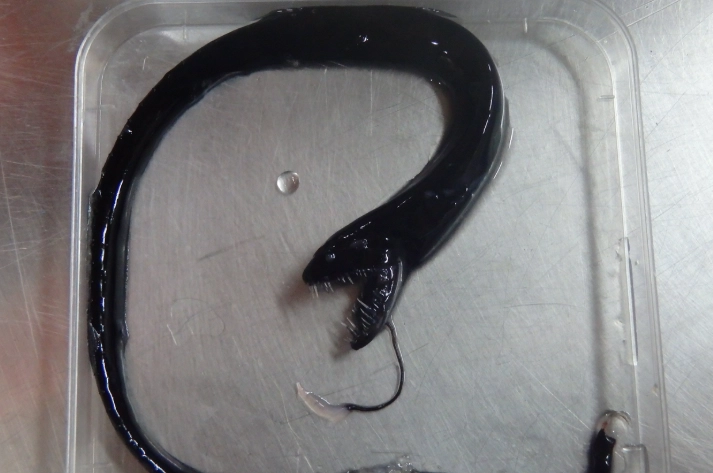
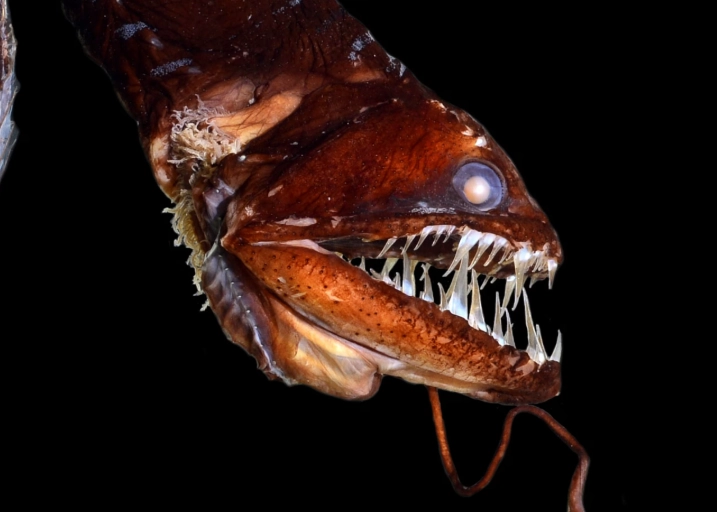
Let's clear up a big point of confusion right away. "Black dragon fish" often refers to several species in the Idiacanthus and related genera. They're small, usually 15 to 40 centimeters long, but what they lack in size, they make up for in sheer terror factor. The females are the ones you see in the haunting photos—long, eel-like bodies covered in velvety black skin that absorbs over 99.5% of light. They have a chin barbel tipped with a bioluminescent photophore (a light-producing organ). Their heads are all jaw and teeth, with fangs so long they can't even close their mouths properly.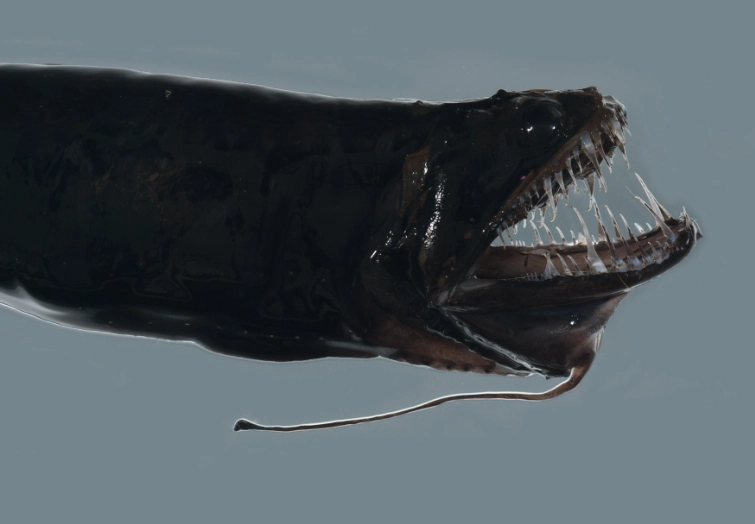
Here's a kicker most generic articles miss: the males are a different story. In many species, the male is a tiny, brownish, and degenerate form. He doesn't hunt. He lacks functional teeth and a stomach. His sole purpose after metamorphosis is to find a female, attach to her with specialized teeth, and essentially become a parasitic sperm packet. It's a brutal, efficient reproductive strategy that saves energy in a food-scarce environment.
Quick Snapshot: Pacific Black Dragonfish
Scientific Name: Idiacanthus antrostomus
Habitat: Mesopelagic to bathypelagic zones of the Pacific Ocean (200 - 2000 meters deep).
Size (Female): Up to 40 cm.
Size (Male): About 5 cm, non-feeding.
Defining Feature: Long chin barbel with bioluminescent lure, enormous hinged teeth.
Diet: Small fish, crustaceans, and anything foolish enough to investigate its light.
How Does the Black Dragon Fish Hunt? A Step-by-Step Nightmare
Its hunting strategy isn't a simple "glow and chomp." It's a multi-layered deception that exploits the specific visual ecology of the deep sea.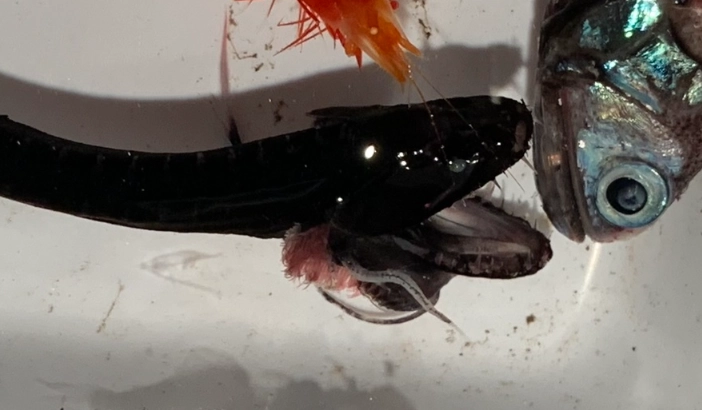
Step 1: The Invisible Ambush. Its ultra-black skin makes it a shadow against a background of shadows. To prey looking upwards, it's nearly invisible against the slightly less dark water above. This isn't just dark skin; it's one of the blackest materials in the natural world, thanks to nanostructures that trap light.
Step 2: The Deceptive Lure. It wiggles that glowing chin barbel. To a hungry shrimp or small fish, this tiny, flickering light might look like a tasty snack—a bioluminescent copepod, perhaps. The lure emits a blue-green light, the wavelength that travels farthest in seawater and matches most deep-sea bioluminescence.
Step 3: The Infrared Vision Advantage. This is the secret weapon. While its lure emits visible blue light to attract prey, the black dragon fish itself can see in the near-infrared spectrum. It has special photoreceptors. How does this help? Many deep-sea creatures are transparent, but their bodies absorb some of this infrared light. So, while the prey sees only the dragonfish's lure in the blue spectrum, the dragonfish might be seeing the prey's silhouette in a different, private light channel. It's like having night-vision goggles while your opponent is blindfolded.
Step 4: The Strike. Its jaw is a piece of biomechanical horror. It's hinged like a snake's, able to swing open to an angle of over 120 degrees. Combined with those long, needle-like teeth, it creates a massive gape relative to its body size, ensuring anything that gets close is not getting away. The strike is fast, and the prey is swallowed whole.
The Engineering of That Jaw
People focus on the teeth, but the jaw joint is the real marvel. It allows for an enormous vertical gape. Think of it not as a mouth, but as a spring-loaded trapdoor. The muscles are optimized for rapid opening, not powerful closing. Once those teeth pierce the prey, it's already over; the fish just needs to guide it down its throat.
Surviving the Crushing Dark: Key Adaptations Beyond the Glow
Bioluminescence gets all the press, but survival down there requires a full toolkit. The black dragon fish's body is a checklist of deep-sea solutions.
- Pressure Resistance: Their cells are saturated with special molecules like TMAO that stabilize proteins against crushing pressure. Their bones are often less mineralized, more flexible.
- Energy Efficiency: They're ambush predators for a reason. Active chasing burns too many calories in a world where a meal might be weeks apart. Their muscles are mostly white, fast-twitch fibers for the explosive strike, not endurance swimming.
- Bioluminescent Camouflage (Counter-illumination): This is crucial and often overlooked. They have photophores along their bellies. By producing a faint, downward-facing glow that matches the dim light filtering from above, they erase their silhouette against the brighter surface when viewed from below. This makes them invisible to predators looking up. They use light not just to hunt, but to hide.
| Adaptation | Function | Human Analogy |
|---|---|---|
| Ultra-Black Skin | Light absorption for near-perfect camouflage. | Wearing Vantablack in a pitch-black room. |
| Chin Barbel Lure | Attracts curious prey with mimicking bioluminescence. | Using a decoy to lure a target into a trap. |
| Infrared Photoreceptors | Sees prey in a private light spectrum. | Having a heat vision setting on your goggles. |
| Hinged Jaw & Long Teeth | Creates massive gape to secure large prey relative to body size. | A mouse trap with springs that open wider than the trap itself. |
| Ventral Counter-illumination | Erases silhouette from below to avoid predators. | Projecting an image of the sky onto your belly while flying. |
Why Scientists Are Obsessed With This Fish
It's not just about the "cool factor." The black dragon fish is a living lab for several cutting-edge scientific fields.
Materials Science: The structure of its ultra-black skin is being studied to develop new, more efficient light-absorbing materials for solar panels, telescopes, and stealth technology. Mimicking nature is often better than inventing from scratch.
Optics and Vision Research: Its ability to produce and see both blue and infrared light is a unique visual system. Understanding how its retina and brain process these dual signals could inspire new imaging and sensor technologies, especially for low-light conditions.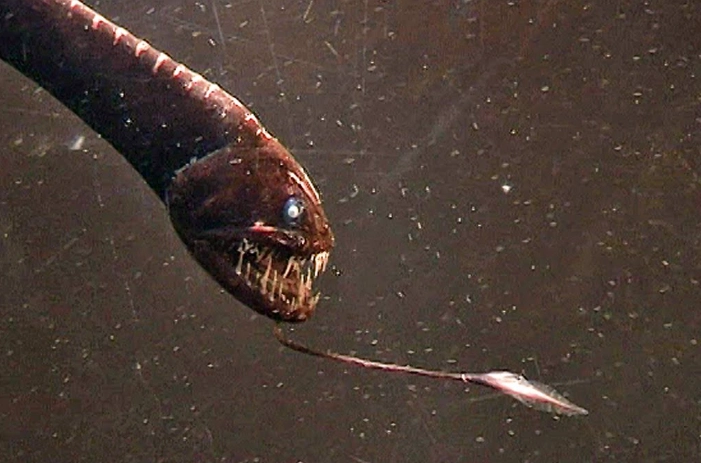
Evolutionary Biology: The extreme sexual dimorphism (the huge difference between males and females) is a textbook example of how intense environmental pressure—like the energy deficit of the deep sea—can warp reproductive strategies. It shows evolution opting for radical efficiency.
Every time an ROV (Remotely Operated Vehicle) from an institution like NOAA Ocean Exploration captures new footage, biologists scramble to analyze its behavior. We're still learning basic things about how often it feeds, its exact depth migrations, and the full purpose of all its different light organs.
Your Black Dragon Fish Questions, Answered
Staring at the black dragon fish, you're not looking at a random freak of nature. You're looking at a logical, if extreme, answer to a very hard set of questions posed by the deep sea. It's a reminder that evolution is an endless tinkerer, and in the absence of light, it crafts its own.
The next time you see a dark room, imagine floating there, forever. Then imagine evolving a lantern to draw in food, a cloak of pure shadow to hide from enemies, and eyes that see the invisible. That's the daily reality for the black dragon fish. It's less of a monster and more of a masterpiece of survival.


Comments
Leave a Comment