Picture this: total darkness, crushing pressure, and freezing cold. This is home for the black dragonfish (Idiacanthus atlanticus), a creature that looks like it swam straight out of a nightmare. But calling it a monster misses the point. It's a masterpiece of evolutionary engineering, built to dominate a world where sunlight never reaches. I've spent years studying deep-sea footage, and every time I see this fish, I'm reminded that the real aliens are right here in our oceans. Forget the Hollywood version. The black dragonfish's reality is far stranger and more clever.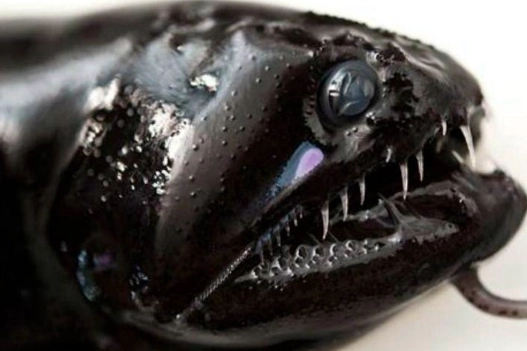
What's Inside?
What Does the Black Dragonfish Look Like?
Let's get the obvious out of the way. This fish is long, skinny, and black as ink. Females, the ones you usually see in pictures, can grow up to 40 cm (about 16 inches). Males? They're a different story entirely—tiny, only about 5 cm, toothless, and they don't even have a working gut. They basically live just long enough to find a female and reproduce. Talk about a life goal.
The most striking feature is the head. It's all teeth and eyes. The jaws are lined with fang-like teeth so long they barely fit inside its mouth. They curve inward, creating a trap that's nearly impossible to escape from. And that chin barbel—the long, thin whisker dangling from its lower jaw—isn't for show. It's a sophisticated fishing rod with a glowing tip, which we'll get to in a second.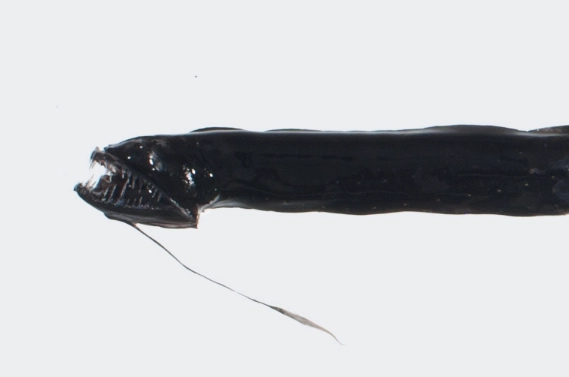
How Does the Black Dragonfish Use Bioluminescence?
This is where the black dragonfish becomes a true deep-sea superstar. Bioluminescence—making their own light—isn't just a party trick. It's a survival toolkit. Unlike most deep-sea fish that produce blue-green light, the black dragonfish has a unique superpower: it can produce red light.
Think of it like night vision goggles. In the deep sea, almost no other creature can see red light. So when the dragonfish switches on its red headlights (located near its eyes), it can illuminate prey without being seen. The prey animal, adapted to see only blue light, is completely blind to the red beam searching for it. It's like having a private spotlight in a crowded, dark room.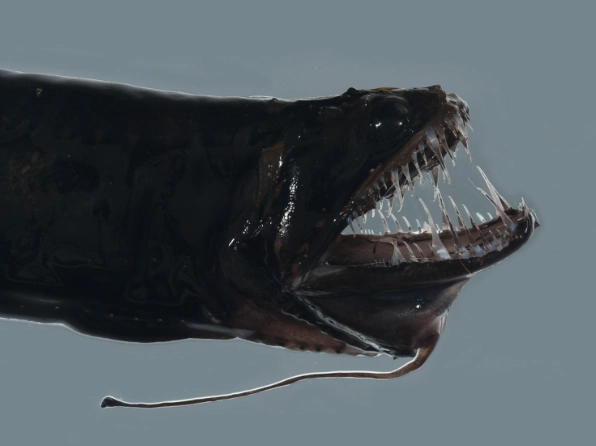
| Light Organ | Location | Probable Function |
|---|---|---|
| Postorbital Photophores | Below the eyes | Produce red light for covert illumination of prey (like a sniper's scope). |
| Barbel Tip | End of the chin whisker | Produces blue-green light to act as a lure, wiggling to mimic small prey. |
| Lateral Photophores | Along the body | Produce blue-green light for counter-illumination (camouflaging its silhouette from below). |
| Suborbital Photophores | Under the eyes (some species) | May act as a "headlight" for general vision or communication. |
That barbel lure is a work of art. It's not just a glowing blob. Researchers like those at the Monterey Bay Aquarium Research Institute (MBARI) have observed its intricate movements, suggesting it mimics the specific jerks and twitches of tiny crustaceans or worms—the perfect snack for the dragonfish's own prey.
How Does the Black Dragonfish Hunt?
Its hunting strategy is a three-step ambush perfected over millennia. It's not a fast chase; it's a patient, calculated trap.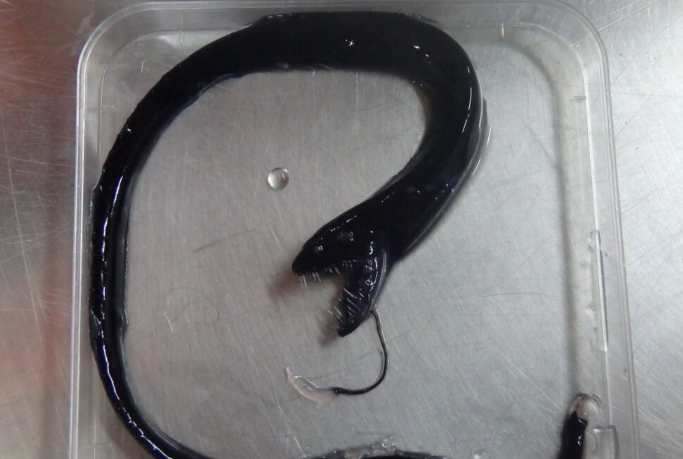
First, it hangs motionless in the water, conserving energy. Its black body vanishes into the darkness. Then, it deploys the barbel. It flicks and wiggles that glowing tip, turning it into an irresistible snack for smaller fish and shrimp. The curious victim approaches, thinking it's found an easy meal.
This is the critical moment. The dragonfish may switch on its red light to get a perfect, clear view of the target. With its massive, expandable jaws, it creates a sudden, powerful suction. The prey is sucked in, and those needle-like teeth ensure there's no going back. The entire strike can happen in milliseconds. One second there's a curious little fish, the next it's gone.
What's on the Menu?
Stomach content studies (yes, they do that) show their diet is versatile:
Small crustaceans: Copepods, ostracods.
Other fish: Especially lanternfish and bristlemouths.
Anything that fits: Their jaws are so flexible they can swallow prey nearly as large as themselves.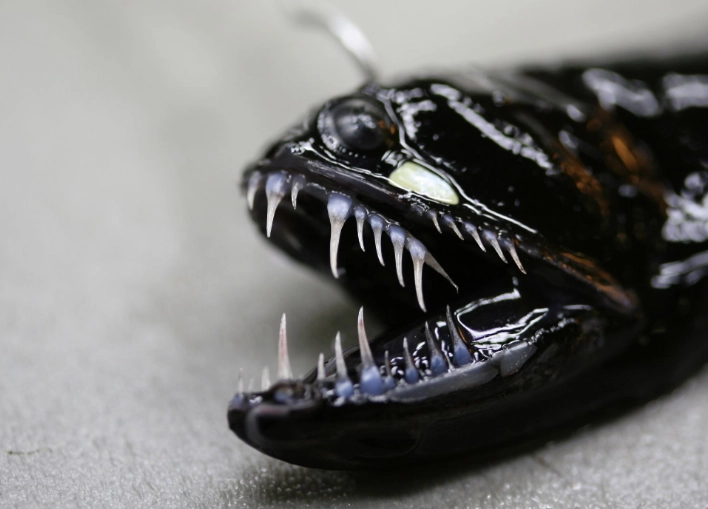
The Bizarre Life Cycle of the Black Dragonfish
The difference between males and females is one of the most extreme in the vertebrate world. It's called sexual dimorphism, and they took it to the max.
Females are the fully-equipped predators we've been describing. Males are larval-looking their entire short lives. They lack the iconic fangs, their digestive system degenerates, and their main purpose is reproductive. They use their large eyes to find a female's bioluminescent signal. Once they mate, they die. All the energy is funneled into the next generation of formidable female hunters.
The larvae themselves are transparent and have eyes perched on long stalks, making them look even more alien than the adults. As they mature, females develop their dark pigment and weapons, while males essentially stop developing.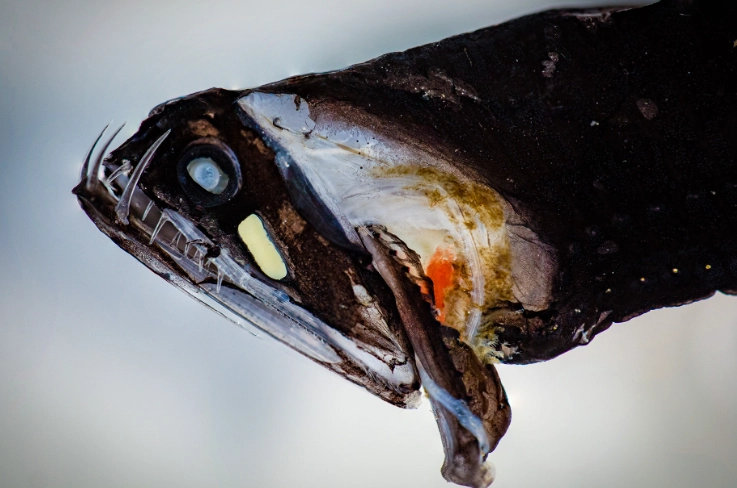
Studying the Unseen: How Scientists Learn About It
We don't catch these fish with rods and reels. Almost everything we know comes from deep-sea trawls and, more importantly, Remotely Operated Vehicles (ROVs). Institutions like MBARI and the Woods Hole Oceanographic Institution send these robotic submarines down to 2000 meters, capturing the first-ever footage of these animals in their natural habitat.
It's challenging work. Bringing a dragonfish to the surface often damages its fragile body. The pressure change is fatal. That's why in-situ observation is gold. An ROV can watch a dragonfish hunt, see how it uses its lights, and document behaviors we could only guess at before. Each dive can rewrite what we thought we knew.
For authoritative information on deep-sea bioluminescence, the National Oceanic and Atmospheric Administration (NOAA) provides excellent educational resources that explain the chemistry and ecology behind this amazing adaptation.


Comments
Leave a Comment