Let's be honest, we've all been there. You're walking home late at night, the street is quiet, and then you hear it. That low, rhythmic "hoo-hoo-hoo" coming from a dark tree. Your heart skips a beat. It's just an owl, you tell yourself. But something about that sound, that presence in the darkness, feels ancient and unnerving. It's not just you. Across cultures and centuries, owls have been wrapped in a cloak of mystery and fear. So, what is it about these birds that gives us the creeps? What is a creepy fact about owls that explains this deep-seated unease?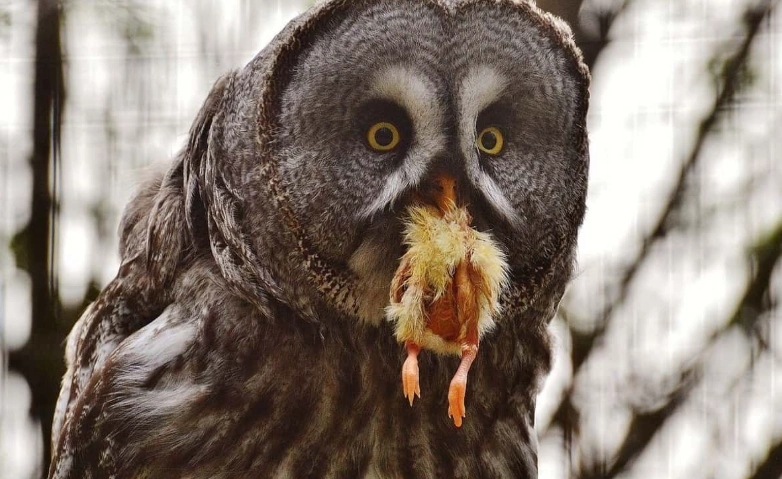
I remember camping as a kid, lying awake in my tent. An owl called, and it sounded so close, like it was right on top of the tent. I didn't dare move. That feeling of being watched by something you can't see in the dark? That's the owl's specialty. This isn't just superstition. The creepiness is baked into their very biology, their behavior, and the stories we've told about them for millennia. We're going to dig into all of that, from the physics of their silent flight to the reason they can stare into your soul by turning their heads almost all the way around.
The Sound of Silence: A Predator You Can't Hear
This is, for my money, the number one creepy fact about owls. They are virtually silent fliers. A barn owl, for instance, can swoop down on a mouse in complete grass without making a whisper of sound. Think about that. In a world where even a falling leaf makes a rustle, a two-foot-wide bird with sharp talons can move through the air like a ghost. How is that even possible?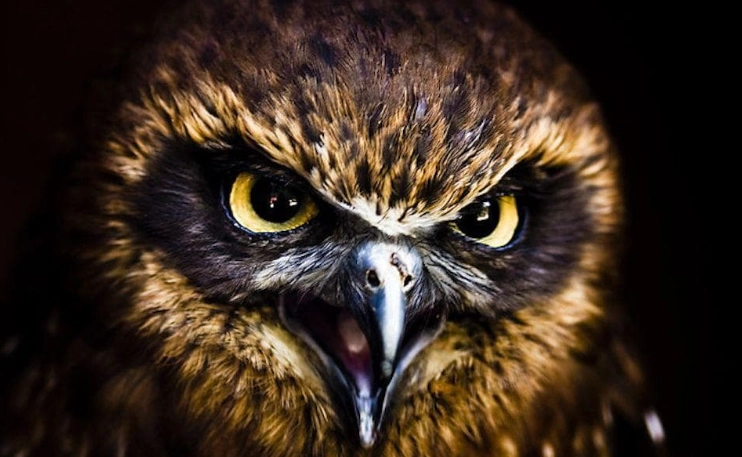
It's an engineering marvel, really, but that doesn't make it less unsettling. Their feathers are the key. Unlike most birds, owl feathers have unique, fringed edges. The leading edge of their primary flight feathers has a comb-like serration, and the trailing edge is soft and fringed. This design breaks up turbulent air that would normally create a whooshing sound. It's like putting a silencer on their wings. Furthermore, the surface of their feathers is covered in a velvety down that absorbs any remaining sound. The Cornell Lab of Ornithology has some fantastic, detailed resources on owl flight adaptations if you want the deep scientific dive.
The evolutionary reason is obvious: it makes them better hunters. Their prey, often small mammals with excellent hearing, never hear death coming. But from a human perspective, it creates a profound sense of vulnerability. Our ears are one of our main night-time warning systems. An owl disables that system completely. You could be standing in a forest, and a great horned owl could glide right past your ear, and you'd never know. That's a power that feels supernatural.
That Head Turn: More Than Just a Party Trick
Okay, we've all seen the pictures. An owl with its head twisted 180 degrees, looking backwards. It's a classic piece of owl trivia, but the reality is even more impressive—and slightly more disturbing. Owls can rotate their heads up to 270 degrees in either direction. That's three-quarters of a full circle. Why do they need to do this?
It's a compensation for a major design flaw. Owls have huge, tubular eyes that are fixed in their sockets. They can't move their eyes like we can. To look around, they have to move their entire head. So evolution gave them an incredibly flexible neck. But here's the creepy part: the anatomy that allows this looks like something out of a horror movie. They have twice as many neck vertebrae as humans (14 vs. 7), and their blood vessels are structured with slack and reservoirs to prevent blood flow from being cut off during extreme rotation. Research from scientific journals has used medical imaging to map this system, revealing a network of adaptations that prevent strokes from all that twisting.
The Mechanics of the Twist
It's not magic; it's biomechanics. Their vertebrae have special socket-and-ball joints that allow for greater rotation. The bone structure also protects the vital arteries, which sit in grooves within the vertebrae rather than running through tight canals. This design prevents pinching. So when you see an owl staring at you from over its own back, you're looking at millions of years of evolution solving a problem in the most unnerving way possible. It's efficient, but it looks deeply wrong to anyone familiar with vertebrate anatomy. It violates our basic understanding of how a neck should work.
I find this fact particularly creepy because it's a reminder of how differently other creatures are built. We project our own physiology onto animals, and when they break those rules so dramatically, it creates a sense of the uncanny. That head turn isn't just quirky; it's a fundamental biological otherness.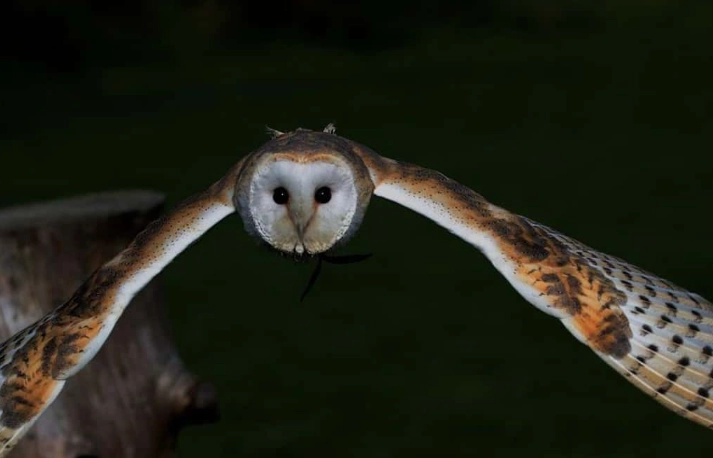
Eyes Like a Demon: Fixed Gaze and Night Vision
Their eyes are the next piece of the puzzle. Owl eyes are massive relative to their skull size. If human eyes were proportionally as large, they'd be the size of oranges. These huge, forward-facing eyes give them superb binocular vision and depth perception, crucial for judging distances when swooping on prey. But they're fixed in place, which contributes to the need for the creepy head rotation.
More unsettling is their night vision capability. Their retinas are packed with rod cells, which are sensitive to low light. They can see in light levels over 100 times dimmer than what a human needs. But there's a trade-off: they see in mostly black and white. Detail and color are sacrificed for the ability to see movement in near-total darkness.
Then there's the tapetum lucidum, that reflective layer behind the retina. It's what causes "eyeshine" when a light hits their eyes at night. That glowing, often red or orange, pair of orbs in the dark woods? Yeah, that's an owl staring right at you. It's a predator's gaze, amplified by biology. The U.S. Department of the Interior's Fish and Wildlife Service notes how this adaptation is common among nocturnal hunters, but on an owl's large, flat face, the effect is particularly intense and human-like in its focus, which is probably why it feels so personal and creepy.
Cultural Baggage: Omens, Death, and Witchcraft
Biology alone doesn't explain the full weight of the creepiness. Human culture has layered on meaning for thousands of years, and most of it is pretty dark. This is where the question "what is a creepy fact about owls?" moves from science to folklore, which can be just as powerful in shaping our perceptions.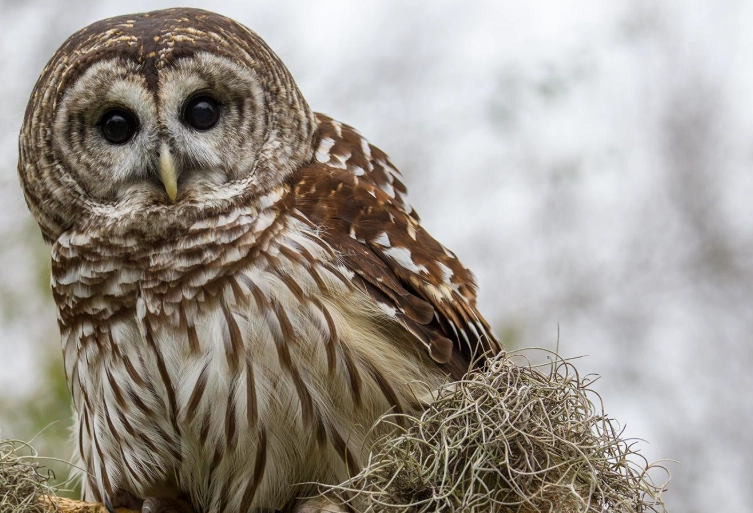
In many Western traditions, owls are harbingers of death or bad luck. In ancient Rome, hearing an owl's hoot was a dire omen. Pliny the Elder wrote about it. In medieval Europe, owls were associated with witches; their silent flight was thought to be them carrying messages for sorcerers, or the witches themselves transformed. This association stuck. Even today, you'll see owls perched on the shoulders of witches in Halloween decorations.
| Culture/Region | Symbolism | Reason/Origin |
|---|---|---|
| Ancient Greece | Wisdom (Athena's bird) | Association with the goddess of wisdom and warfare. A rare positive spin, but Athena was also a fierce, strategic warrior. |
| Roman Empire | Death, Doom | Hooting predicted deaths of emperors and commoners alike. Seen as a cursed bird. |
| Medieval Europe | Witchcraft, Evil | Nocturnal habits and silent flight linked to dark magic and heresy. |
| Some Native American Tribes | Death, Messenger to/from Spirit World | Seeing or hearing an owl could signify impending death or a message from ancestors. |
| Mesopotamia | Demoness (Lilitu) | Associated with a female demon that preyed on pregnant women and infants. |
| Modern Pop Culture | Mystery, Gothic Horror | Used in films and books to instantly create an eerie, suspenseful atmosphere. |
This table shows the heavy trend. The positive association in Greece is a famous exception, but even Athena's owl was a symbol of cool, calculating intelligence that could see in the dark—useful, but not exactly warm and cuddly.
In other parts of the world, the story is similar. In some African and Native American traditions, owls are messengers from the spirit world or psychopomps, creatures that guide souls to the afterlife. In parts of India and the Middle East, they can be seen as bad luck. This global convergence on death and the occult is striking. It suggests that the owl's biological traits—nocturnality, silent flight, eerie calls, glowing eyes—naturally predispose the human mind to link them with the unknown and the feared.
I think the witchcraft association is particularly potent. It personalizes the fear. It's not just a random bird; it's an agent of a malevolent human-like intelligence. That's a powerful narrative that turns a natural predator into a supernatural spy.
Other Spine-Chilling Owl Behaviors and Traits
Beyond the big three (silence, head turn, eyes), there's a whole catalog of smaller facts that add to the unsettling picture. Let's run through a few.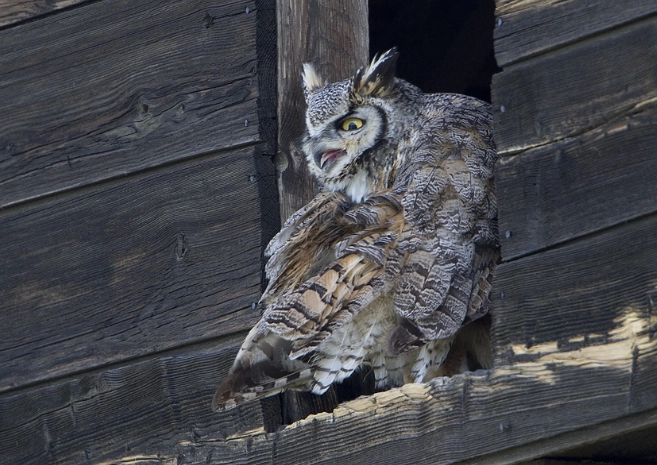
Their Calls Aren't Just Hoots
We think of the classic "hoot," but owls have a vast and disturbing repertoire. Barn owls don't hoot at all; they let out a long, drawn-out, raspy screech that sounds like a person being murdered. I'm not exaggerating. It's a sound that has probably caused more than a few 911 calls. Barred owls have a call often described as "Who cooks for you? Who cooks for you-all?" which can sound weirdly conversational and creepy in a deep forest at night. Then there are the hisses, clicks, and bill-snapping sounds made by owlets or defensive adults. These sounds break our expectations of what a bird should sound like, venturing into the realm of the monstrous or the human-in-distress.
They Are Apex Predators
Great horned owls are often called "flying tigers." They have one of the strongest grips in the avian world. They regularly prey on skunks (they have a poor sense of smell, so they don't care), other birds of prey like falcons, and even cats and small dogs. This isn't common, but it happens. Knowing that a silent, nearly invisible predator with crushing talons is sharing your suburban neighborhood can be a creepy realization. They are not delicate birds; they are powerful, ruthless hunters perfectly adapted to kill.
Their Diet and Dining Habits
Owls swallow small prey whole. Later, they cough up a pellet containing the indigestible parts—bones, fur, teeth. Finding an owl pellet is a cool science project, but think about the process: a neat package of death compacted and expelled. It's efficient but grim. Furthermore, some owl species practice siblicide. In times of scarce food, the older, stronger owlet will kill and sometimes eat its weaker sibling. It's a brutal survival strategy that clashes with our notions of family and nurture in the animal kingdom.
Camouflage Masters
An owl's plumage isn't just for silence; it's for disappearing. Many species have intricate patterns of browns, grays, and whites that melt perfectly into tree bark. A great horned owl can sit on a branch three feet from your face and you'd walk right past it. This ability to be present but unseen plays directly into the fear of being watched. It makes them ghosts in their own habitat.
Addressing Your Creepy Owl Questions
Let's tackle some of the specific questions people have when they dive down this rabbit hole. These are the things you might be wondering after learning all this.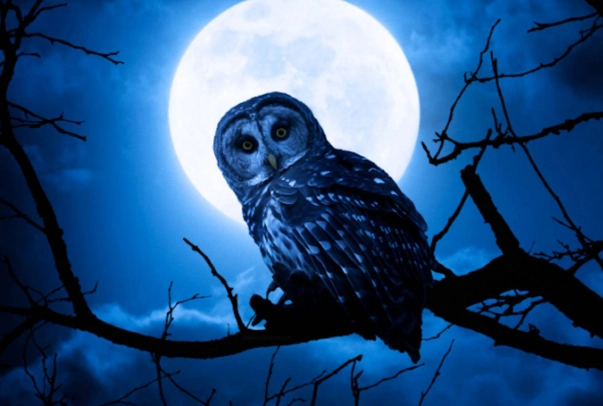
Are owls dangerous to humans?
Almost never. Owls are wild predators and will defend their nests fiercely. There are rare accounts of large owls like Eurasian Eagle-Owls swooping at hikers who got too close to a nest, which can be scary and potentially cause injury from their talons. But unprovoked attacks on humans are virtually unheard of. The danger is entirely to their natural prey. The fear is psychological, not physical.
Why do owls hang around cemeteries?
This reinforces the death association, but the reason is practical. Cemeteries are often quiet, wooded areas with old trees that provide excellent nesting holes. They also tend to have healthy populations of rodents (voles, mice) because of the open grass and limited human disturbance. So an owl in a cemetery is just finding good real estate and a reliable grocery store. Our brains, primed by folklore, make the spooky connection.
Is it bad luck to see or hear an owl?
According to science? No. It's a sign of a healthy local ecosystem. According to centuries of folklore from dozens of cultures? Well, the jury's been out on that for a few thousand years, and the verdict has often been "yes." I find it fascinating how a biological event—seeing a successful predator—gets filtered through such a thick layer of human storytelling. The luck isn't in the owl; it's in how you choose to interpret the encounter.
What is the creepiest owl species?
This is subjective, but contenders include:
- Barn Owl: For its blood-curdling screech and ghostly white face.
- Great Horned Owl: For its sheer power, intense stare, and status as an apex predator.
- Eastern Screech-Owl: Its trilling call can sound like a ghostly horse whinnying, and its gray morph looks like a perfect piece of gnarly tree bark come to life.
Personal vote goes to the barn owl. That scream is unmatched.
Living With the Creepiness: Appreciation Over Fear
After all this talk of silent death and omens, it's worth taking a step back. Owls are not evil. They are not supernatural. They are exceptionally well-adapted birds playing a crucial role in controlling rodent populations. The creepiness we feel is a testament to their perfection as nocturnal hunters. It's our own human psychology reacting to traits that evolution honed over eons.
Learning about these facts should inspire awe more than fear. The silent flight is an aerodynamic miracle. The head turn is a masterpiece of circulatory and skeletal adaptation. Their role in ecosystems is vital. Organizations like The National Audubon Society work to conserve owl habitats and educate the public about these incredible birds, creepy facts and all.
The next time you hear that hoot in the night, instead of fear, maybe you can feel a connection to the wild world that still exists just beyond our porch lights. You're hearing a living dinosaur, a master of physics and biology, going about its business. That's pretty cool, even if it is also, undeniably, a little creepy.
So, what is a creepy fact about owls? It's the totality of their being—a perfect storm of adaptation that happens to push all of our primal fear buttons. They are the original ghosts in the machine of nature, and that's why they'll forever fascinate and unsettle us.
Comment